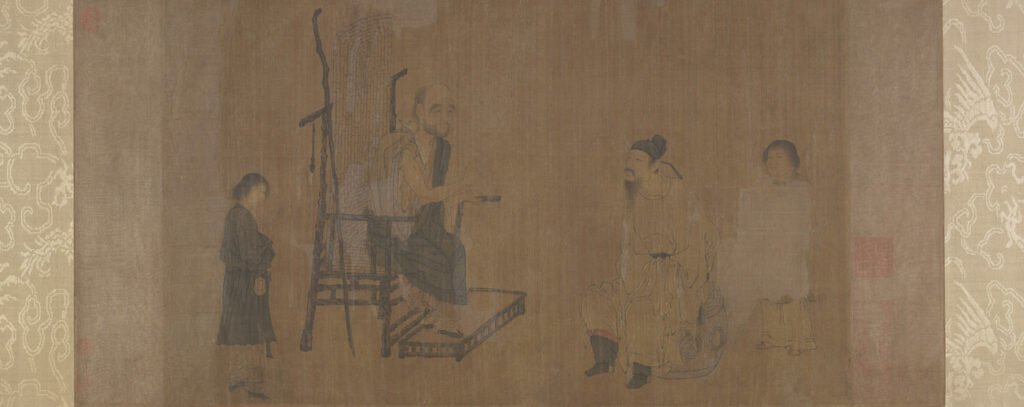
The greatest calligraphy in Chinese history was stolen by a trick, and painters could not resist the scene. Xiao Yi and the Orchid Pavilion Manuscript depicts the moment of the con.
The story is Tang era lore. The monk Biancai guards Wang Xizhi’s Orchid Pavilion Preface, the most coveted manuscript in the empire. The emperor sends Xiao Yi, disguised as a scholar, to befriend him and steal it. The painting shows the two in conversation, the manuscript presumably near, trust being quietly exploited. It is a picture about desire for art turning into state theft.
Versions of this subject circulate under several old masters, and the Palace Museum scroll is one of them. What stays constant is the psychology. Xiao Yi must seem harmless. Biancai must seem safe. The drama is entirely in the manners. A good painter makes betrayal look like friendship, which is exactly the point.
The tale also tells us how the Tang court valued calligraphy. An emperor would run a long confidence game for a scroll. That tells you what counted as treasure. The painting is therefore a document about value as much as about plot.
Look closely and the picture is uncomfortable. We are watching a man lose his prize to a performance of warmth. The fancier the manners, the colder the calculation.
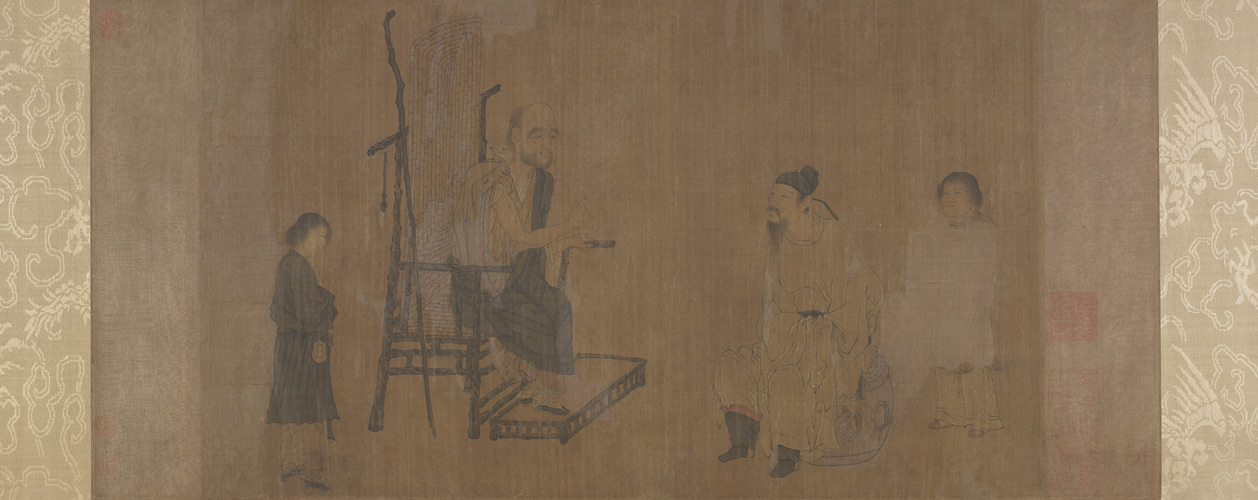
Object details
| Name | Xiao Yi and the Orchid Pavilion Manuscript (萧翼赚兰亭图卷) |
|---|---|
| Artefact no. | 新00186239 |
| Category | Chinese Paintings (绘画) |
| Period | 人物 |
| Collection | The Palace Museum, Beijing |
| Source | Palace Museum Digital Collection (数字文物库) |
Image © The Palace Museum. View the original in the Palace Museum collection.