
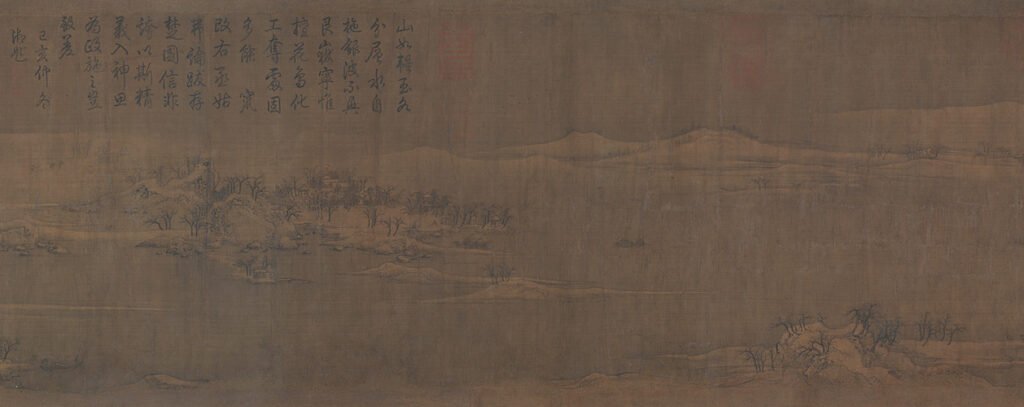
Emperor Huizong painted snow the way he painted everything, with absolute control and a faint cold elegance. His handscroll Snowy River and Returning Boats is winter as imperial taste.
A frozen river runs the length of the scroll. Boats pull toward shore, fishermen move against the white, and the banks are rendered in pale ink with almost no colour. Huizong uses emptiness as structure. The snow is the paper left bare, and the few dark strokes, a tree, a figure, a returning hull, carry the whole weight of the scene.
He was the same emperor who painted the dragon rock and ran the great Song art academy. Snow landscape was a respected Song genre, and Huizong approached it as a connoisseur setting a standard. The composition is calm and measured, every element placed. There is no wildness, only rule.
That restraint is the signature. Huizong’s paintings are never loose. They are the work of a centralised eye, a man who graded other painters for a living and applied the same exactness to his own hand. The coldness is partly the season and partly the temperament.
He lost an empire, as his dragon rock picture foreshadows. But the snow he painted is still falling, eight hundred years on, on a river that never thawed in the telling.
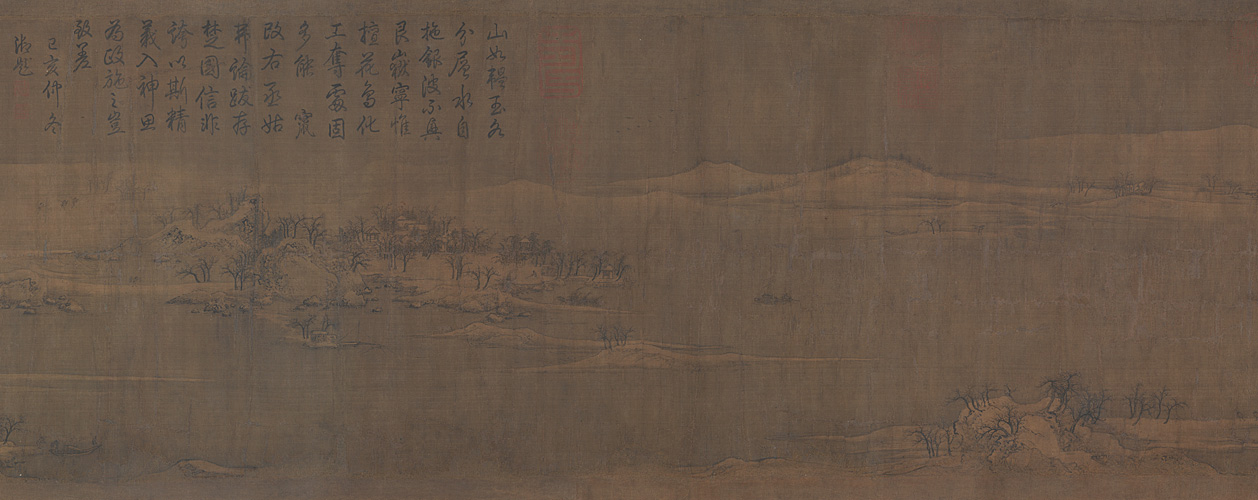
Object details
| Name | Snowy River and Returning Boats (赵佶雪江归棹图卷) |
|---|---|
| Artefact no. | 新00138445 |
| Category | Chinese Paintings (绘画) |
| Period | 山水 |
| Collection | The Palace Museum, Beijing |
| Source | Palace Museum Digital Collection (数字文物库) |
Image © The Palace Museum. View the original in the Palace Museum collection.