
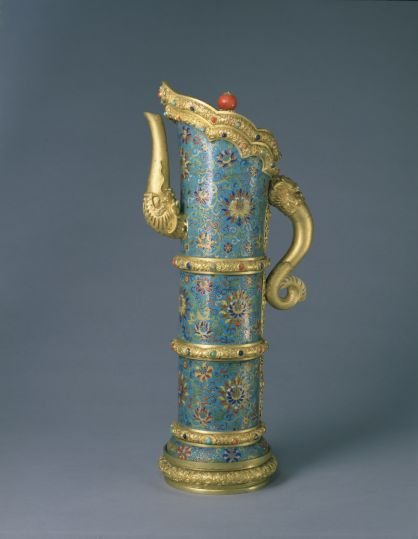
A duomu ewer is a shape borrowed from the grasslands, a tall pot with a curved spout and a domed lid used across Central Asia and the Tibetan plateau. The Qianlong court had it made in cloisonne and then set semi precious stones into the bands, turning a nomad’s vessel into a court jewel.
The form is the news. Most cloisonne follows Han Chinese vessel types, but this one follows a foreign one, its silhouette dictated by a way of pouring practised far to the west. The inlaid stones, turquoise and the rest, answer a taste for mixed materials that the steppe admired and the Qing absorbed.
Qianlong collected the world’s forms the way he collected its maps. A ewer like this is less a utensil than a quiet claim that the empire’s reach included the shapes it borrowed as well as the lands it held.
Cloisonne usually stays in two dimensions of colour. Here it steps into three, with stones raised above the enamel, a small act of empire in fired glass and rock.
Object details
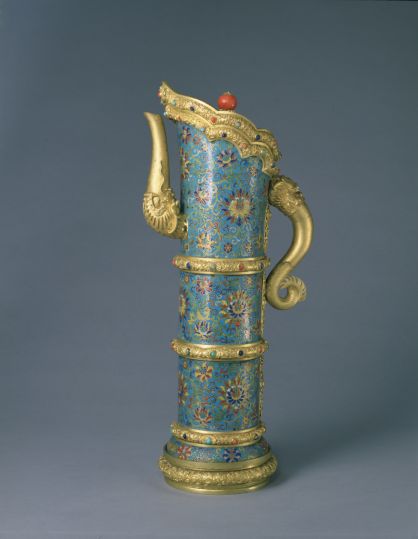
| Name | Qianlong-mark cloisonne ‘Interlocking Lotus’ ewer with inlaid stones (乾隆款掐丝珐琅缠枝莲纹嵌石多穆壶) |
|---|---|
| Artefact no. | 故00116333 |
| Technique | Cloisonne enamel with inlaid stones (掐丝珐琅嵌石) |
| Period | Qing dynasty, Qianlong reign (1736-1795) |
| Collection | The Palace Museum, Beijing |
| Source | Palace Museum Digital Collection (数字文物库) |
Image © The Palace Museum. View the original in the Palace Museum collection.