
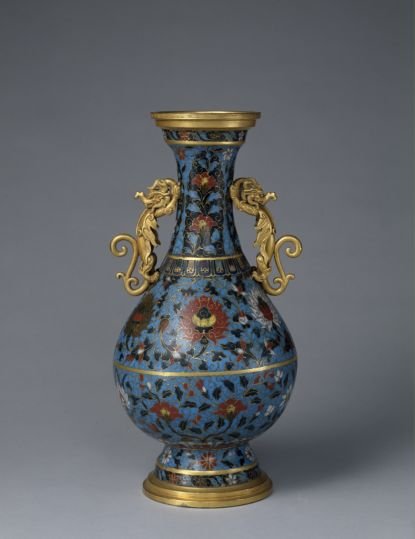
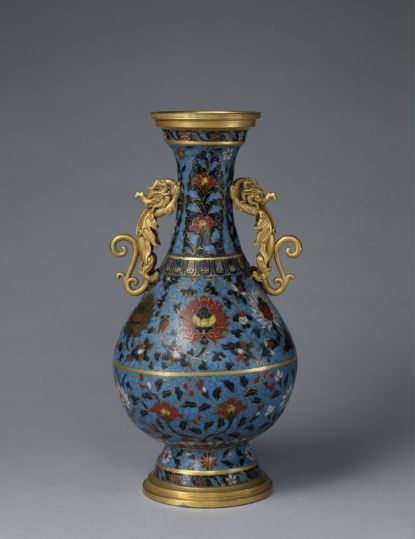
Two dragons crouch at the shoulders of this Jingtai-mark vase, gripping the neck so the vessel can be carried. Below them runs the interlocking lotus that defines the period’s cloisonne: wire bent into scrollwork, filled with enamel, fired to a glassy calm.
The Jingtai court favoured blue grounds and disciplined repeats. This vase shows the formula at its confident best, the dragons giving the symmetric pattern a point of tension, a pair of eyes watching the room.
Cloisonne of this date is rarer than its Qing descendants. The Ming made less of it, and what survives carries the weight of a technique still finding its imperial voice.
A vase like this was never for flowers alone. It was a statement about control, of colour, of fire, of a pattern held perfectly still.
Object details
| Name | Jingtai-mark cloisonne ‘Interlocking Lotus’ vase with dragon handles (景泰款掐丝珐琅缠枝莲纹龙耳瓶) |
|---|---|
| Artefact no. | 新00007033 |
| Technique | Cloisonne enamel (掐丝珐琅) |
| Period | Ming dynasty, Jingtai reign (1450-1457) |
| Collection | The Palace Museum, Beijing |
| Source | Palace Museum Digital Collection (数字文物库) |
Image © The Palace Museum. View the original in the Palace Museum collection.