
A crane takes off from the lid of a bronze vessel, and three centuries of rigid ritual art end. The Lotus-and-Crane hu is the moment Chinese bronzes learned to move.
Cast in the Spring and Autumn period and unearthed at Xinzheng, Henan, in 1923, the square hu pairs a lotus bloom with a crane about to fly, flanked by dragons in relief. The ritual vessel stops being a sealed block and starts breathing.
The Bronze Age had spent a thousand years on symmetry and awe. This object trades some of that awe for life. Archaeologists read it as the hinge between the solemn early bronzes and the restless, naturalistic work that followed.
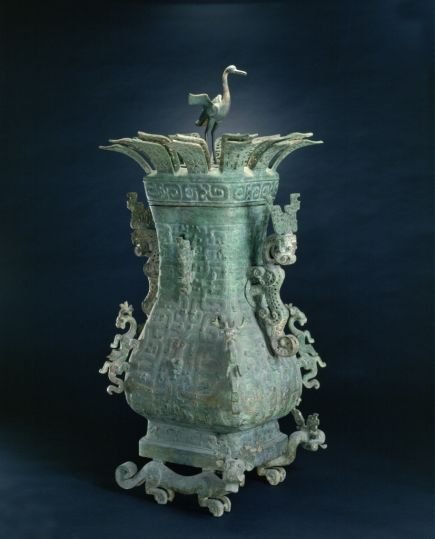
Object details
| Name | Lotus crane square pot (莲鹤方壶) |
|---|---|
| Artefact no. | 新00005538 |
| Technique | Bronze |
| Period | Imperial dynasty |
| Collection | The Palace Museum, Beijing |
| Source | Palace Museum Digital Collection (数字文物库) |
Image © The Palace Museum. View the original in the Palace Museum Digital Collection.