
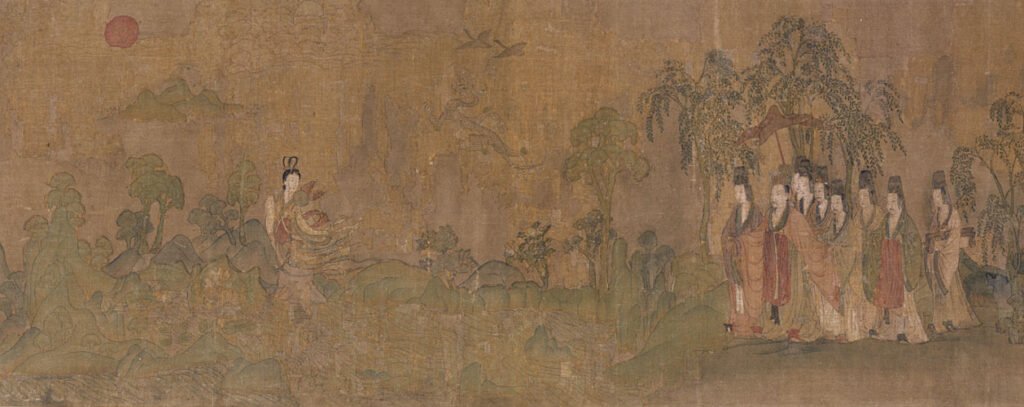
Goddess of the Luo River (Gu Kaizhi, Song dynasty copy)
On the bank of the Luo River, a prince meets a goddess he cannot keep.
Goddess of the Luo River (Gu Kaizhi, Song dynasty copy) Read More »

On the bank of the Luo River, a prince meets a goddess he cannot keep.
Goddess of the Luo River (Gu Kaizhi, Song dynasty copy) Read More »

An eighteen-year-old painted the most ambitious landscape in Chinese history and then vanished.
A Thousand Li of Rivers and Mountains (Wang Ximeng) Read More »

The most famous painting in China got copied for five hundred years.
Ming Dynasty’s Qingming Riverside Picture Scroll Read More »

Most people in the West can name the Mona Lisa. Almost none can name the handscroll a teenager painted in three years and never lived to repeat, or the jade boulder the size of a small car that a dozen men carved for a Qianlong emperor who wanted to own a myth. We spend our
The Palace Treasures Nobody Taught You Read More »

A cup the size of a coin, painted with hens, chicks, and a peony, and prized out of all proportion to its size for five hundred years. The Chenghua chicken cup is the masterpiece of doucai, a Ming technique that sets underglaze blue against overglaze colours so the two meet at a precise line. The
Chenghua Chicken Cup (Doucai) Read More »

A rice paddy and a silkworm tray, painted with the care usually reserved for emperors, because the Yongzheng emperor asked for exactly that. The Gengzhi tu is an old format, pictures of farming and weaving, here reworked in the Yongzheng court with the ruler himself sometimes inserted into the labourer’s place. It is propaganda with
Yongzheng Agricultural and Sericultural Pictures Read More »
Twelve women, each alone in a furnished room, caught between a glance at the viewer and a return to their own thoughts. The Twelve Beauties are court paintings long attributed to the circle of the Yongzheng emperor, possibly after his own designs. They are remarkable for treating interior space and objects, a vase, a zither,

A young emperor sits armoured on a white horse and looks straight out of the picture, the review halted so the painting could get him exactly right. The Grand Review portrait shows the Qianlong emperor in the full regalia of a Manchu ruler inspecting his troops, a blend of Chinese court painting and the tighter
Qianlong at the Grand Review Read More »

A landscape in silk, every mountain and cloud outlined by a technique that refuses to smudge, so that the picture reads as clearly as if it had been cut from the weave. Shen Zifan was the leading kesi master of the Southern Song, turning painted compositions into tapestries with a patience the age revered. Where
Kesi Silk Tapestry by Shen Zifan Read More »

A silk picture built thread by thread so that even the smallest leaf has a clean edge, as if the painting had been grown rather than woven. Zhu Kerou was a woman artisan of the Song whose kesi, a silk tapestry that leaves no weave-direction blur, was prized by connoisseurs as equal to painting. The
Kesi Silk Tapestry by Zhu Kerou Read More »