

An eighteen-year-old painted the most ambitious landscape in Chinese history and then vanished. Wang Ximeng finished A Thousand Li of Rivers and Mountains in 1113 and left almost no other trace.
The scroll runs close to 12 metres in blue and green mineral pigment, ground azurite and malachite laid over a gold ground. Emperor Huizong, painter and patron both, set the brief; Wang executed it inside a year. It is the supreme statement of blue-green landscape, the mode that traded realism for monumentality.
Blue-green was old when Wang painted it, a Tang manner the Song usually preferred to soften. He did the opposite, pushing it to a scale no one had attempted. The result outlived the dynasty that commissioned it and the painter who made it.
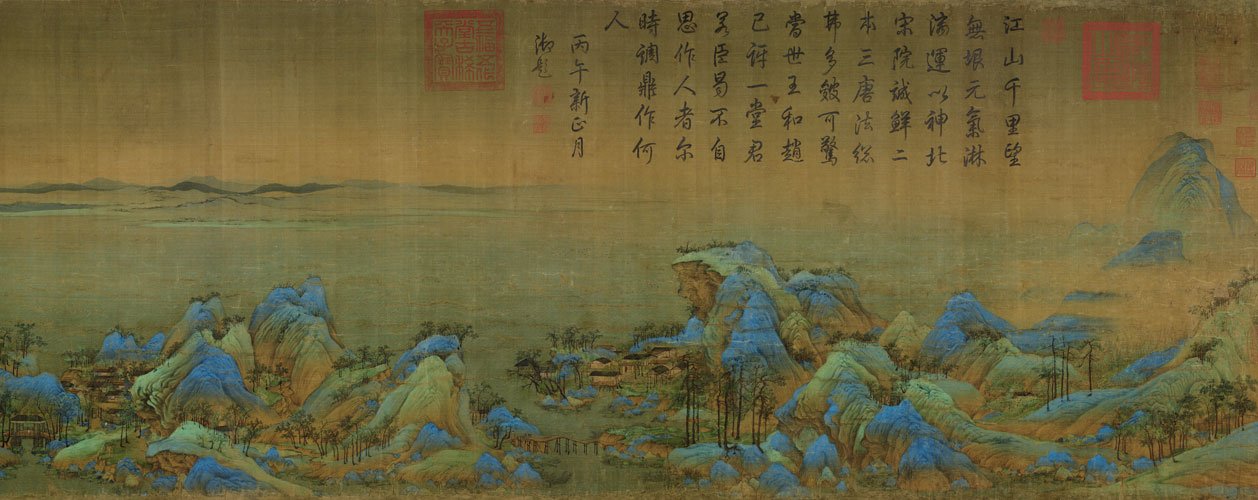
Object details
| Name | Ink handscroll (王希孟千里江山图卷) |
|---|---|
| Artefact no. | 新00146004 |
| Technique | Ink |
| Period | Imperial dynasty |
| Collection | The Palace Museum, Beijing |
| Source | Palace Museum Digital Collection (数字文物库) |
Image © The Palace Museum. View the original in the Palace Museum Digital Collection.