
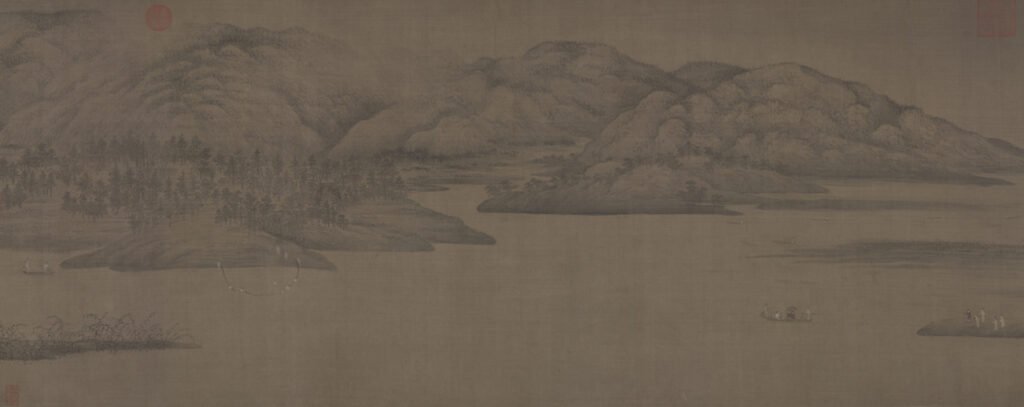
Before there was a Southern School of Chinese landscape, there was Dong Yuan. His scroll Xiao and Xiang Rivers is one of the works that started it. Everything soft about later Chinese painting begins here.
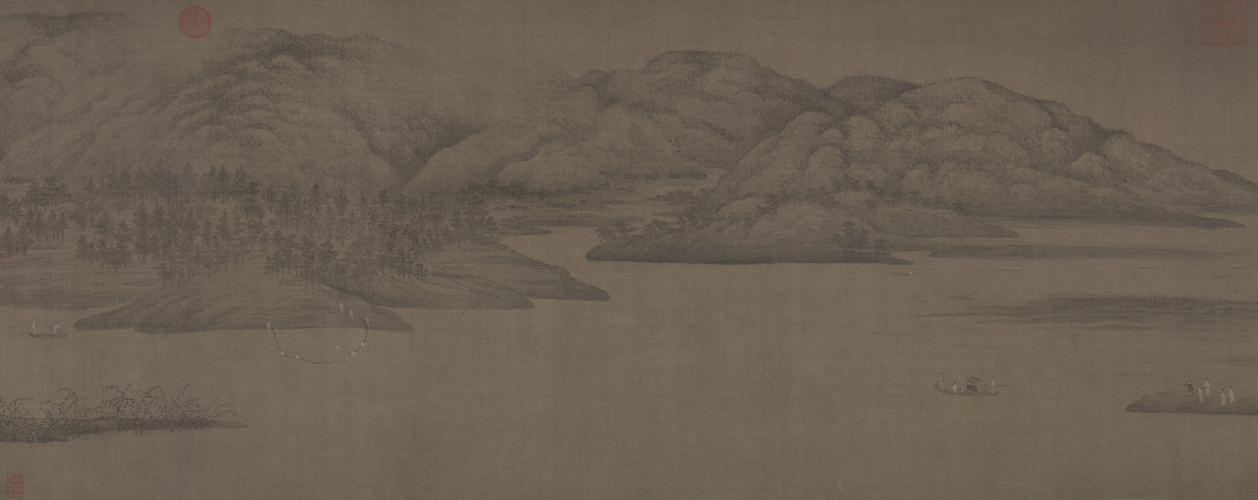
The title names two rivers in Hunan, the Xiao and the Xiang. Dong Yuan painted them the way humidity feels, not the way a map would. Low hills melt into mist. Tiny fishing boats dot the water. Trees are dabs of ink. There is no drama, no peak to conquer. The land just breathes.
Dong Yuan was a court painter in the Southern Tang state during the tenth century. He worked in the region south of the Yangtze, and he painted its actual weather: wet, green, endless. Northern painters of the same era drew tall cliffs and bare mountains. Dong Yuan drew the south, and the south won. His manner became the foundation of literati landscape for the next eight hundred years.
The technique is the quiet revolution. He used short horizontal strokes to build up earth and foliage, a method later writers called the hemp-fibre texture. From a distance the picture is a wash of atmosphere. Up close it is thousands of small honest marks. That balance, grand yet built from nothing, is the gift.
Look at this scroll and you are looking at a region’s self image. The Jiangnan landscape that Dong Yuan invented is still the China that painters reach for when they want to suggest home.
Object details
| Name | Xiao and Xiang Rivers (董源潇湘图卷) |
|---|---|
| Artefact no. | 新00147099 |
| Category | Chinese Paintings (绘画) |
| Period | 山水 |
| Collection | The Palace Museum, Beijing |
| Source | Palace Museum Digital Collection (数字文物库) |
Image © The Palace Museum. View the original in the Palace Museum collection.