
This ruyi scepter is cut from white jade, the stone the Chinese court valued above every other because it could be worked but never rushed. Jade does not bend; the carver removes everything that is not the object.
The cut is the point. Jade carving rewards a sure hand and punishes a second thought, so the ruyi scepter reads as a single decision rather than a sequence of them.
Jade carried the moral vocabulary of the Chinese court, the stone against which character itself was measured.
A ruyi scepter like this was made to outlast its owner by centuries, and it has. The white jade still carries the chill it had when it left the Imperial dynasty bench.
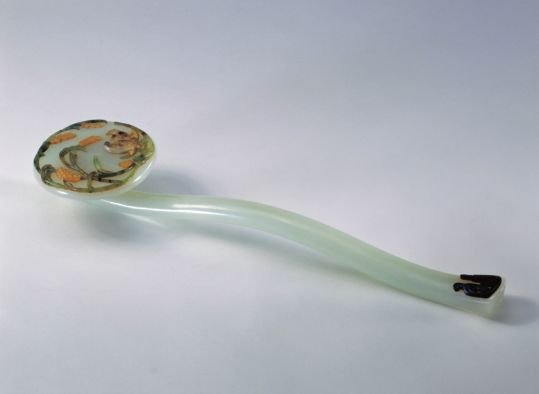
Object details
| Name | White jade inlaid with colorful stone quail Ruyi (白玉嵌彩石鹌鹑如意) |
|---|---|
| Artefact no. | 故00093886 |
| Technique | White jade (白玉) |
| Period | Imperial dynasty |
| Collection | The Palace Museum, Beijing |
| Source | Palace Museum Digital Collection (数字文物库) |
Image © The Palace Museum. View the original in the Palace Museum Digital Collection.