
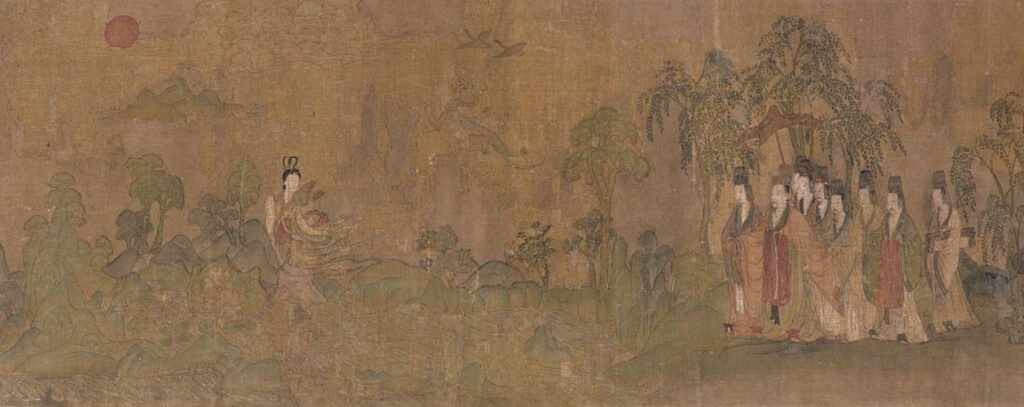
The most famous love poem in Chinese literature became the most copied painting in Chinese art. The Goddess of the Luo River, after Gu Kaizhi, is the Palace Museum’s Song witness to that obsession.
The source is the Luo River Ode, written by Cao Zhi in the third century, a tale of a mortal who meets and loses a river goddess. Gu Kaizhi, in the fourth century, is said to have illustrated it, and almost every later master tried the same. The subject offered everything a painter wanted, a beautiful deity, a longing hero, and a river that keeps them apart.
The Palace Museum scroll is a Song copy of Gu’s lost version, and it is the most influential surviving witness to the composition. Processions of attendants, the goddess floating, the prince watching, all rendered with the calm linearity of early figure style. Through the copy we read Gu’s idea of romance as distance, desire that the water will not permit.
Why the endless copying. The ode is short, musical, and heartbreaking, and it let painters show feeling without breaking court decorum. A goddess is safe to desire because she is impossible. The picture is therefore both romance and restraint, which is exactly why it travelled so well.
We do not have Gu’s hand. We have a Song hand that loved his enough to preserve it. The Luo goddess still crosses the water, eight hundred years later, unreachable as ever.
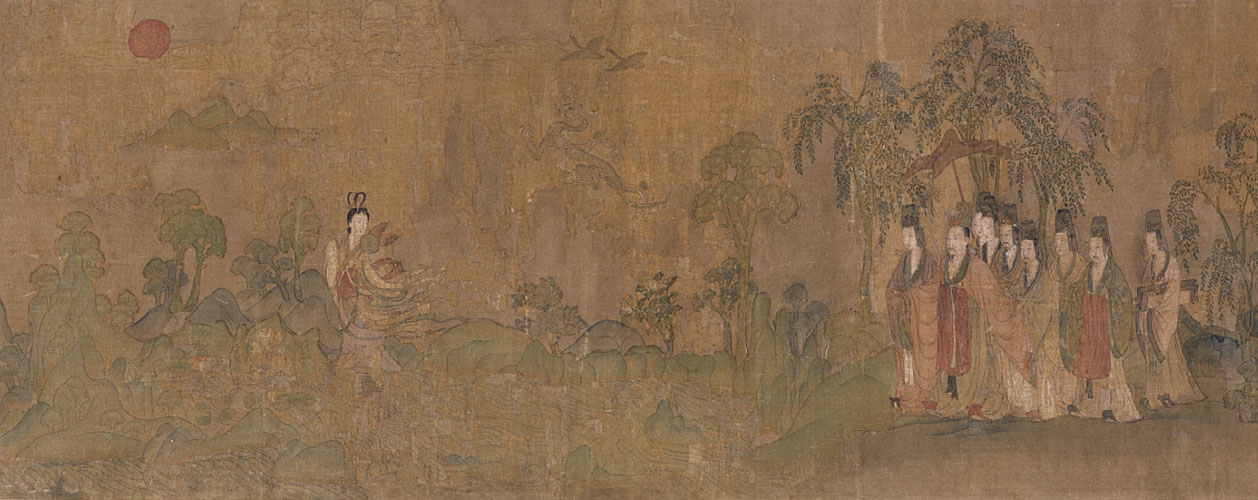
Object details
| Name | The Goddess of the Luo River (顾恺之洛神赋图卷(宋摹)) |
|---|---|
| Artefact no. | 新00147329 |
| Category | Chinese Paintings (绘画) |
| Period | 人物 |
| Collection | The Palace Museum, Beijing |
| Source | Palace Museum Digital Collection (数字文物库) |
Image © The Palace Museum. View the original in the Palace Museum collection.