
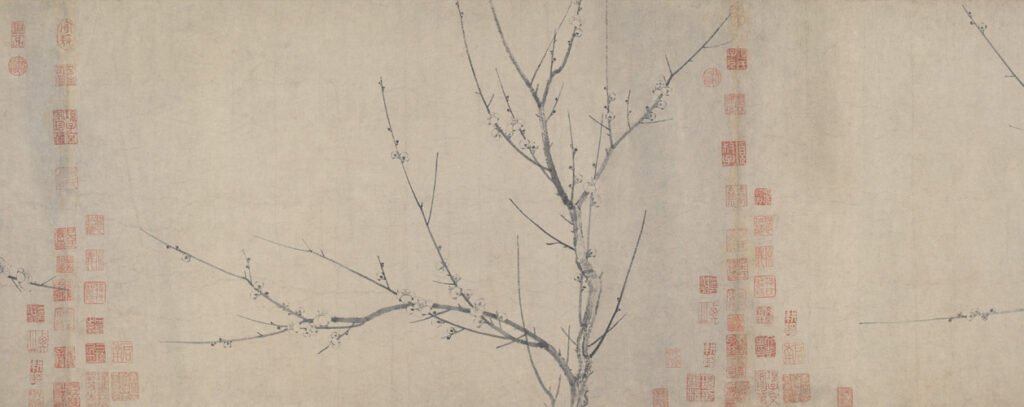
Yang Wujiu took one flower and four states of it and made a whole argument about restraint. His handscroll Four Plum Blossoms is the ink plum painting at its source.
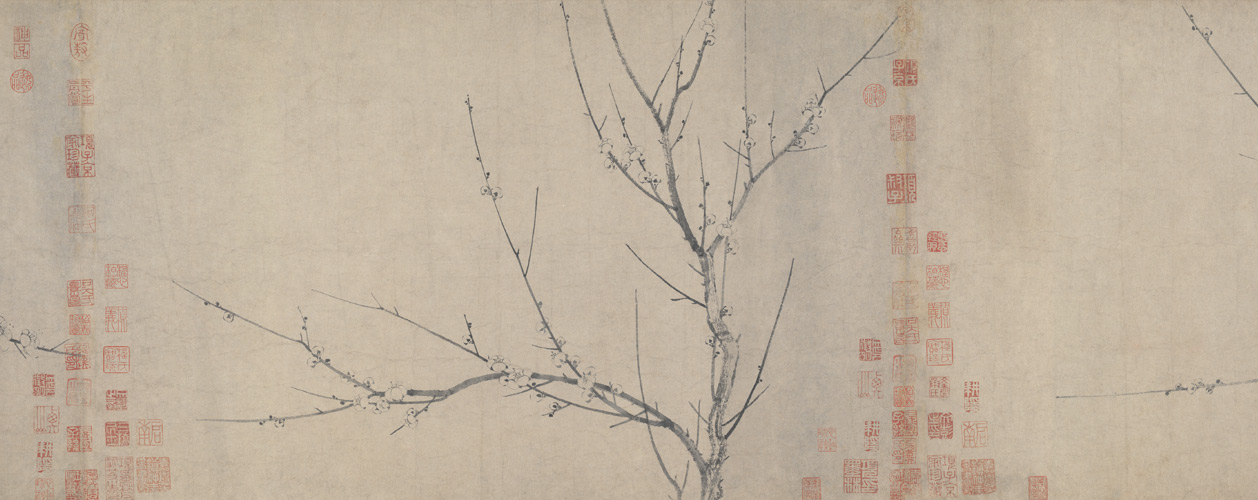
The scroll moves through a plum tree’s year. First the buds. Then half open flowers. Then full bloom. Then the petals fall and the branches stand bare. No colour, only ink, applied so the tree feels both observed and idealised. Yang Wujiu is credited as a founder of the ink plum, the painting of blossoms in monochrome that became a literati obsession.
He lived in the twelfth century, across the shift from Northern to Southern Song. The plum, which flowers in the cold before spring, was already a symbol of integrity under pressure. To paint it in plain ink rather than bright colour was a moral as much as an aesthetic choice. You were showing character, not decorating a wall.
The drawing is confident and a little loose, which is the point. Ink plum was never about likeness alone. It was about the speed and certainty of the brush, the trace of a mind in motion. Later painters copied Yang’s formula for centuries because it was simple enough to personalise and hard enough to master.
Four moments of one tree, four hundred years of imitation. The plum became the test every scholar painter had to pass.
Object details
| Name | Four Plum Blossoms (扬无咎四梅花图卷) |
|---|---|
| Artefact no. | 新00054045 |
| Category | Chinese Paintings (绘画) |
| Period | 花鸟 |
| Collection | The Palace Museum, Beijing |
| Source | Palace Museum Digital Collection (数字文物库) |
Image © The Palace Museum. View the original in the Palace Museum collection.