
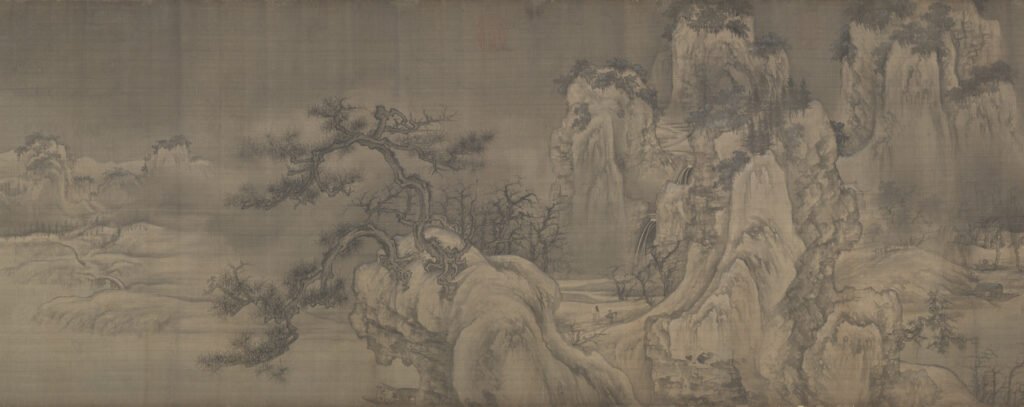
Wang Shen was a Song prince by marriage and an artist by temperament. His scroll Fishing Village in Light Snow is what happens when a man with a court education and a court salary decides to paint the cold honestly.
The scene is a riverbank under thin snow. Sparse trees, low hills, a few huts, and a fisherman who looks half frozen. Wang Shen used two old vocabularies at once. The bones of the picture are blue and green, the bright mineral colours of Tang imperial landscape. The mood is northern Song ink, pale and withdrawn.
He lived in the eleventh century and married an imperial princess, which gave him access to the circle around Su Shi and Mi Fu. Those men were redefining what a painter was supposed to be, a scholar first and a craftsman second. Wang Shen sat inside that conversation. His painting carries both worlds, the formal colour tradition and the new literary restraint.
The snow is the subject, not the setting. Wang Shen leaves the paper blank where the snow falls, so the cold is the absence of ink. That negative space is the whole point. The viewer completes the weather. It is a quiet, confident trick, and it became a standard move.
A prince who could have painted anything chose a poor fishing village in winter. That choice tells you where literary taste was heading in the Song.
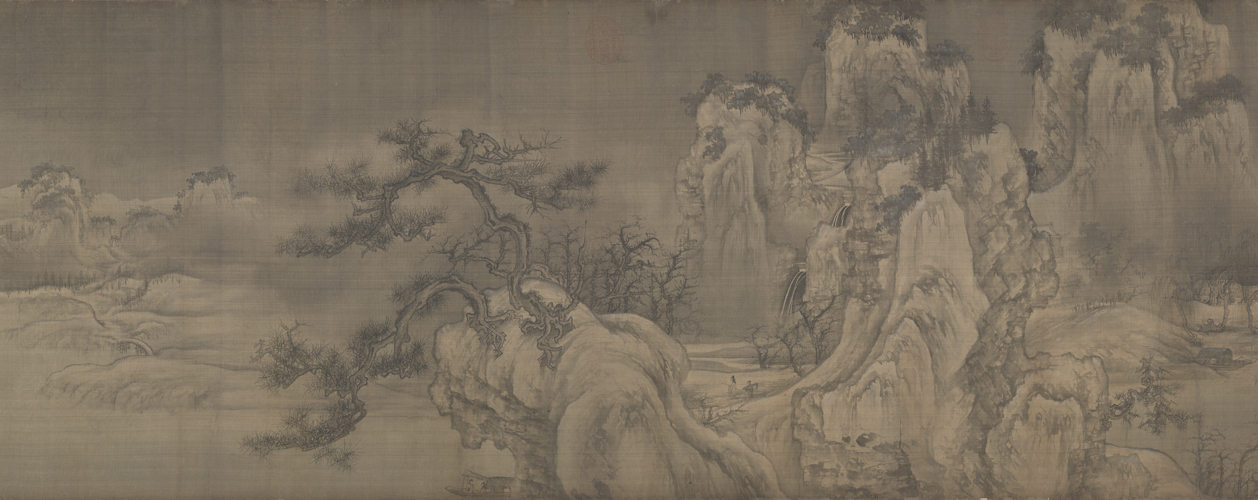
Object details
| Name | Fishing Village in Light Snow (王诜渔村小雪图卷) |
|---|---|
| Artefact no. | 新00093902 |
| Category | Chinese Paintings (绘画) |
| Period | 山水 |
| Collection | The Palace Museum, Beijing |
| Source | Palace Museum Digital Collection (数字文物库) |
Image © The Palace Museum. View the original in the Palace Museum collection.