
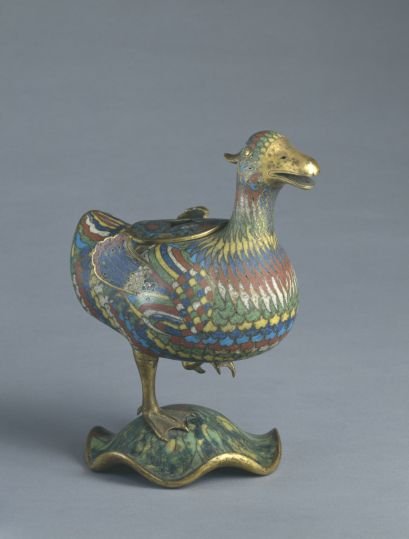
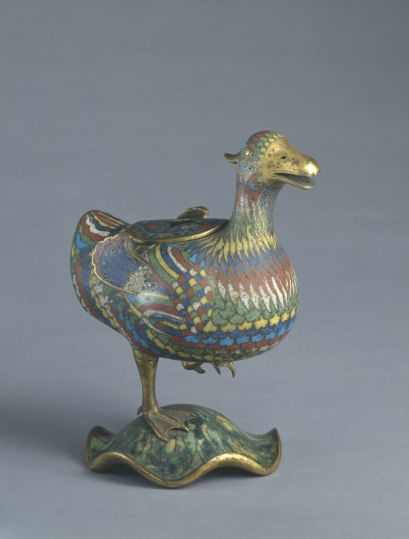
A pair of mandarin ducks is a Chinese emblem of conjugal fidelity, the birds said to pine if separated. The Qing workshop modelled one in cloisonne and hollowed it into an incense burner, so scent issued from a symbol of devoted marriage.
The duck is built in the round, head turned, plumage drawn in wire and filled with enamel in a dozen closely related blues and whites. Cloisonne suited the feather because the technique loves small, bounded fields of colour.
An object like this belonged to the private rooms of the court, a gift or a furnishing charged with a wish for a harmonious union. It is ornament with a brief, spoken softly in enamel.
The Ming made cloisonne grand and public. The Qing also made it small and personal, and this duck is the quieter half of that story.
Object details
| Name | Cloisonne mandarin-duck form incense burner (掐丝珐琅鸳鸯式香熏) |
|---|---|
| Artefact no. | 故00119633 |
| Technique | Cloisonne enamel (掐丝珐琅) |
| Period | Qing dynasty, imperial workshop |
| Collection | The Palace Museum, Beijing |
| Source | Palace Museum Digital Collection (数字文物库) |
Image © The Palace Museum. View the original in the Palace Museum collection.