
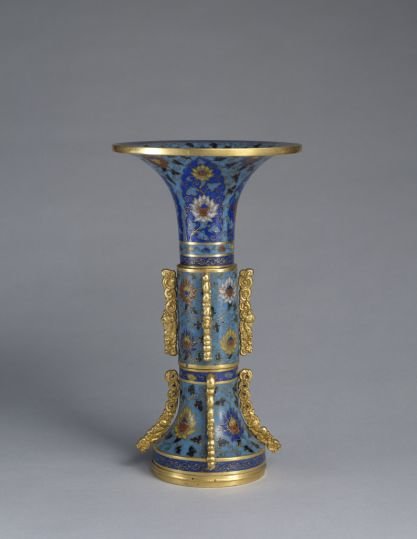
The Xuande emperor’s court built this beaker in copper and glass rather than bronze. It is a gu, an ancient ritual shape, here remade in cloisonne, the craft where thin wire is bent into a pattern, fixed to a metal body, and packed with coloured enamel before firing.
Cloisonne is slow, exact work. A craftsman draws the scrolling lotus in brass wire, solders it down, fills every cell with enamel paste, fires, polishes and gilds. The ground is a deep blue, the colour that would, a generation later, give the whole craft its Chinese name, Jingtai blue.
What reads as decoration is also a record. The interlocking lotus is a Buddhist motif carried into a court vessel, and the Xuande reign mark on the base names the workshop, the reign, and the standard of patience expected of it.
The beaker stands as a small argument about Ming taste. Not ink and paper this time, but fire and metal, holding one of China’s oldest forms in one of its newest materials.
Object details
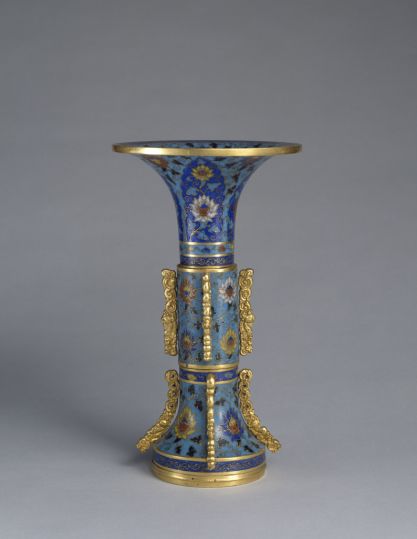
| Name | Xuande-mark cloisonne ‘Interlocking Lotus’ gu beaker (宣德款掐丝珐琅缠枝莲纹出戟觚) |
|---|---|
| Artefact no. | 故00116101 |
| Technique | Cloisonne enamel (掐丝珐琅) |
| Period | Ming dynasty, Xuande reign (1426-1435) |
| Collection | The Palace Museum, Beijing |
| Source | Palace Museum Digital Collection (数字文物库) |
Image © The Palace Museum. View the original in the Palace Museum collection.