
A bowl arrived from the Mughal court and a Chinese emperor could not stop looking at it. The Hetian white-jade bowl inlaid with gold was a gift from Hindustan that reset Qing taste.
The form is Hindustani, the inlay Islamic: gold wire and coloured stones set into pale jade, a craft the Mughals had perfected. Qianlong admired it enough to have the imperial workshops produce Chinese versions, and he wrote poems about the original.
The bowl is a small record of a global court. Jade came from Hetian, the technique from Delhi, the appetite from Beijing. Objects like this are how empires admitted influence without calling it that.
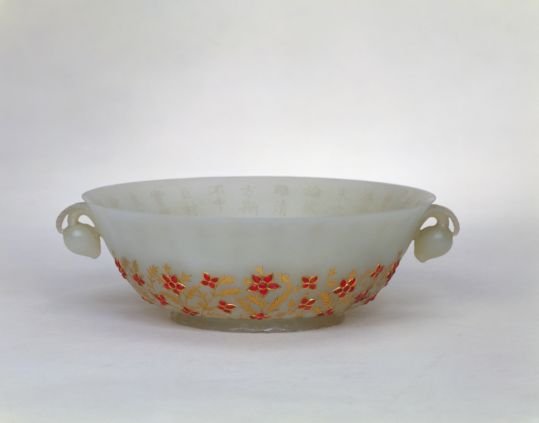
Object details
| Name | Khotan white jade bowl with gold and gemstones (和阗白玉错金嵌宝石碗) |
|---|---|
| Artefact no. | 故00103943 |
| Technique | White jade (白玉) |
| Period | Jin dynasty (1115-1234 CE) |
| Collection | The Palace Museum, Beijing |
| Source | Palace Museum Digital Collection (数字文物库) |
Image © The Palace Museum. View the original in the Palace Museum Digital Collection.