
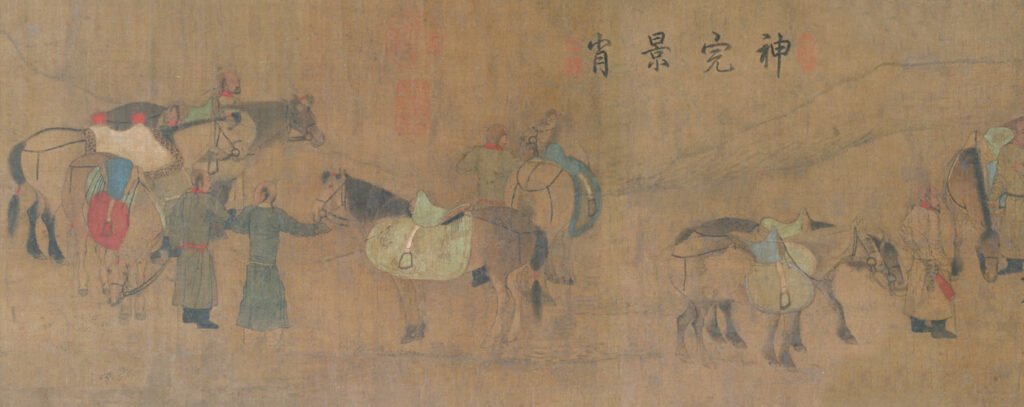
Most surviving Tang and Five Dynasties figure painting shows courtiers. Hu Gui pointed his brush the other way, at the nomads on the steppe, and gave them dignity.
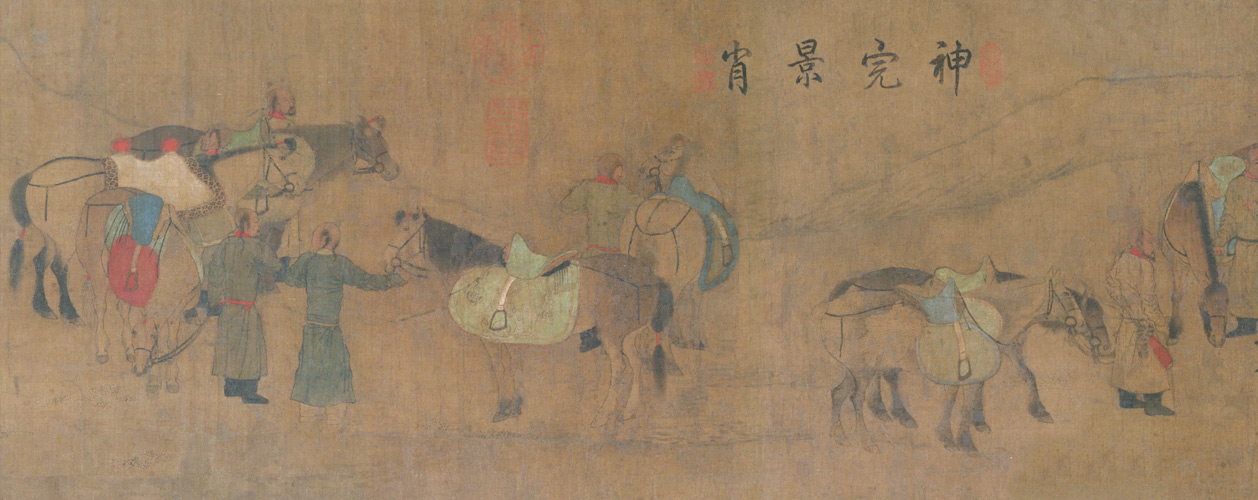
His scroll Nomads at Rest depicts Khitan horsemen halted on a journey. They dismount, tend animals, pass a cup. The movement is loose and earthly, not the stiff formality of a court banquet picture. You can feel the dust and the fatigue. Hu Gui was known precisely for painting the life of the northern tribes, their horses, their felt tents, their unguarded hours.
He worked in the tenth century, a time when the Khitan Liao state bordered and then pressed the Chinese dynasties. Chinese painters had little vocabulary for steppe life, and Hu Gui built one. His animals are convincing, his riders unglamorous. That honesty is rare in a period that usually painted its neighbours as barbarians or not at all.
The picture is a record as much as an artwork. For a modern viewer it is one of the few visual accounts of nomadic daily life from the Chinese side of the frontier, drawn by someone who clearly watched it closely rather than imagining it.
A painting of rest is also a painting of preparation. These men will ride again. Hu Gui lets us sit with them for the pause.
Object details
| Name | Nomads at Rest (胡瓌卓歇图卷) |
|---|---|
| Artefact no. | 新00013910 |
| Category | Chinese Paintings (绘画) |
| Period | 人物 |
| Collection | The Palace Museum, Beijing |
| Source | Palace Museum Digital Collection (数字文物库) |
Image © The Palace Museum. View the original in the Palace Museum collection.