
Collections / Chinese Art / Qing Dynasty
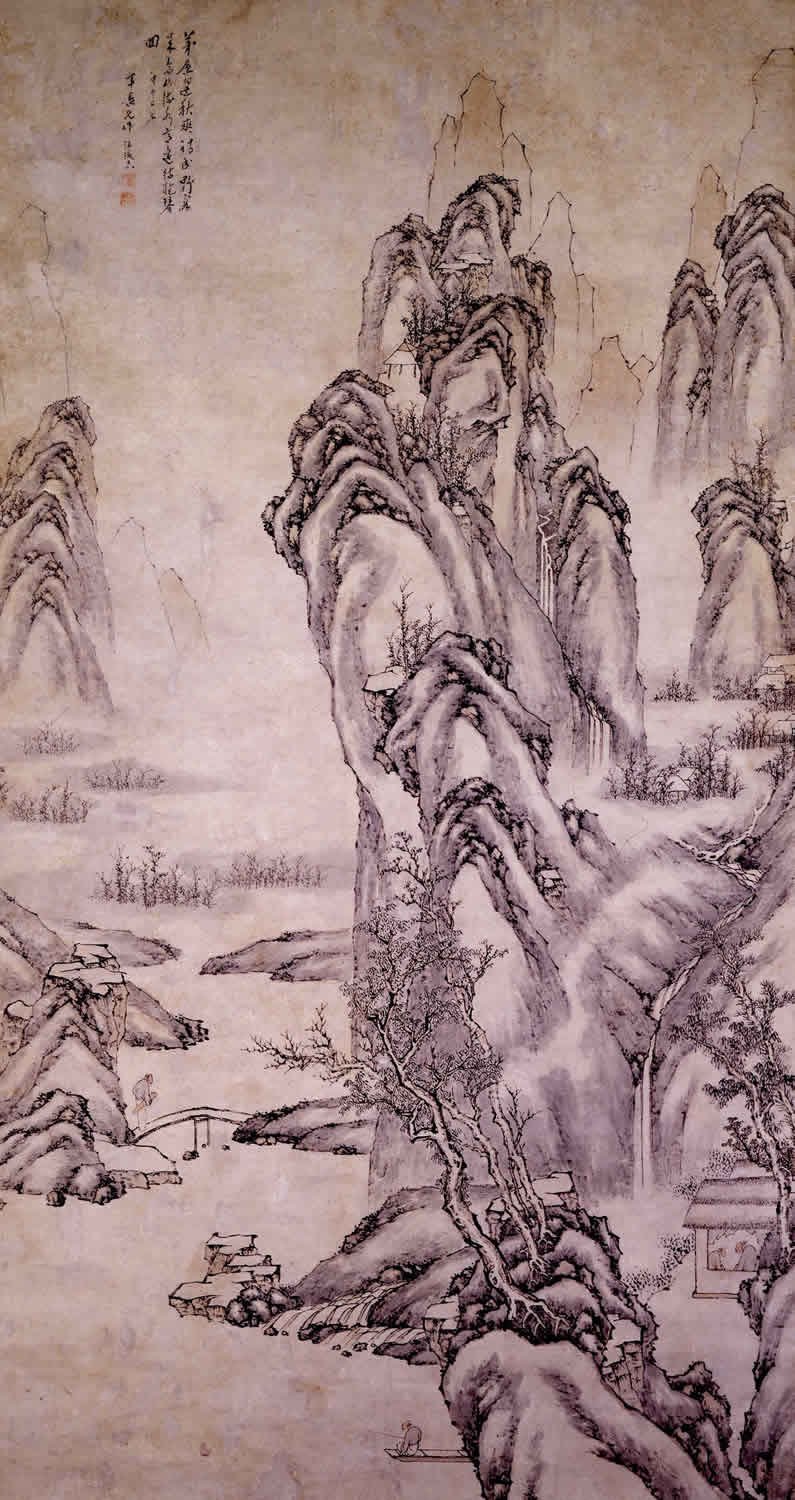
Wang Houlai
Autumn Landscape
Period: Qing dynasty (1644–1911)
Medium: Hanging scroll; ink and color on paper
Dimensions: 76 in. × 36 1/4 in. (193 × 92 cm)
Classification: Paintings
Curatorial Description
Wang Houlai stands as the premier figure in the painting circles of Guangdong during the early Qing dynasty. Versed in both civil and military affairs, Wang held a military post in his early years, where he was credited with suppressing bandits and quelling insurgents. Yet, he was also a man of letters, founding the Fenjiang Poetry Society, which attracted scholars and celebrities from far and wide. In his later years, he retired behind closed doors to read and travel amidst landscapes.
Wang’s trajectory—from active service to reclusive cultivation—reflects a broader shift in the mindset of the literati during this era. This work, Autumn Landscape, was completed in 1740 (the fifth year of the Qianlong reign), when the Qing dynasty was entering its golden age.
The painting’s clean, pale, and distant brushwork, combined with the towering rock peaks, faintly reveals the influence of Jianjiang (Hongren) of the Xin’an School. Wang’s ancestral home was Shexian, Anhui—the same as Jianjiang’s—establishing a deep geographical bond. Furthermore, Wang once traveled to Fujian specifically to “embrace the scenic beauty of Wuyi,” a region where Jianjiang had also resided and left behind numerous works.
While Jianjiang utilized the brush style of the Yuan master Ni Zan to express the sorrow of a “loyalist” (yimin) after the fall of the Ming, Wang Houlai’s adoption of the Xin’an style and his stylistic tracing back to Ni Zan stemmed from different motivations. For Wang, this artistic lineage was a reflection of personal experience, a dedication to the orthodoxy of brush and ink, and a pursuit of aesthetic refinement rather than political resistance.