
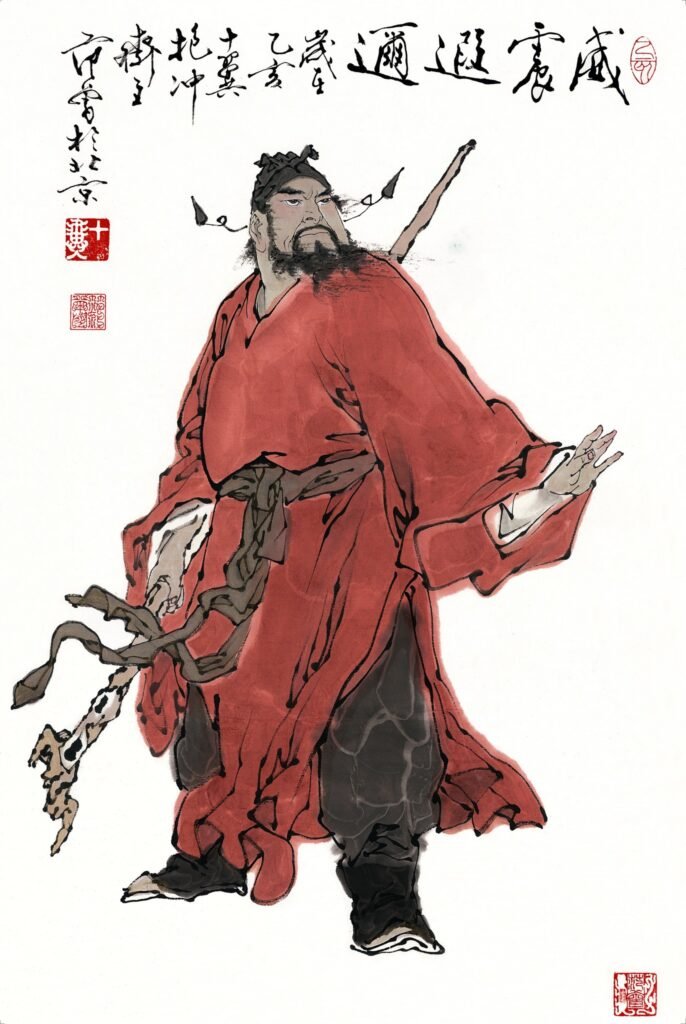
When vermilion silk billows across rice paper, its folds rendered in thick, ink-drenched lines like wind-tossed waves, Zhong Kui’s eyes—two burnt ink (焦墨) dots, sharp as red-hot nails—pierce through the page. Fan Zeng’s 1995 painting Zhong Kui: Guardian of the Realm is more than a portrait; it is an explosion of traditional symbolism, a visual manifesto of justice, and a collective imagination of a “protector” for contemporary China.
Fan Zeng’s Zhong Kui: A Symbol of Justice Reimagined
Fan Zeng, born in 1938, emerged from the turmoil of the Cultural Revolution to become a torchbearer of traditional culture in the 1980s. Zhong Kui, the ancient ghost hunter of Chinese folklore, became his muse. Unlike the ferocious, otherworldly figure of folk tales, Fan’s Zhong Kui is a humanized guardian—a man of flesh and blood, clad in a crimson robe saturated with mineral zhusha (cinnabar) for enduring brilliance, his posture tense yet dynamic. He stands in a dingzibu stance (T-step), body angled as if poised to strike.
His face, deepened to a jujube-red hue, features bushy brows like drawn swords and a beard executed in feibai technique—strands of ink embracing blank spaces to create a soft, textured effect that tempers his fierceness.
Every detail serves purpose: a sword in his right hand bears chanzhiwen motifs (intertwined branches symbolizing evil’s binding) on its sheath; his left hand forms the Taoist “sword finger” gesture for spellcasting; a sash coils like a serpent at his waist, representing dominion over malice. These elements fuse into a figure embodying wei er bu kong—awe-inspiring yet never terrifying—marking a deliberate departure from folk archetypes.
For Fan, Zhong Kui’s “wei zhen xia er” (power resonating through heaven and earth) transcends ghostly exorcism. It champions justice against lurking corruption and inequity. The crimson robe signals fortune; the sword stands as a bulwark against evil; his piercing but uncruel gaze issues a silent decree: “Evil has no place here.”
This reimagining resonated deeply with 1990s China. As the country embraced market reform, people craved stability and moral clarity. Fan’s Zhong Kui became a visual anchor—an icon of hope in a rapidly changing world. His paintings sold for millions (a 2018 auction of Zhong Kui: God of Valor fetched 800,000 RMB), proving that traditional symbols could thrive in a modern context.
Black Myth: Zhong Kui: A Digital Reckoning with Tradition
If Fan Zeng’s Zhong Kui is a visual symbol, then Black Myth: Zhong Kui—the upcoming game from the creators of Black Myth: Wukong—promises to be a narrative revolution. Where Wukong redefined Sun Wukong as a complex rebel (not just a trickster), Zhong Kui aims to peel back the layers of the ghost hunter’s myth.
The game’s premise hints at a more human Zhong Kui. Legend says he died by suicide after being rejected from the imperial exam for his ugliness—an injustice that turned him into a guardian of the underworld. Black Myth may explore this trauma: Was his death a result of societal prejudice? Does he harbor resentment toward the living? How does he reconcile his role as a ghost hunter with his own “ghostly” existence? These questions could transform Zhong Kui from a static symbol into a tragic hero—a figure of loneliness, anger, and quiet nobility.
The team’s track record suggests a commitment to depth. Wukong’s success (over 10 million global sales) came from its ability to balance epic action with emotional storytelling. For Zhong Kui, this could mean gameplay that reflects his dual nature: combat against malevolent spirits (using his sword and spells) intertwined with moments of reflection (visiting the human world, interacting with mortals). The game’s visuals—likely to be as stunning as Wukong’s—will reimagine Fan’s iconic red robe in 3D, making the fabric flow like real silk, the ink lines pop like brushstrokes, and Zhong Kui’s eyes glow with a digital intensity that mirrors the painter’s “jiaomo” (burnt ink).
Two Visions, One Legacy
Fan Zeng and Black Myth represent two sides of the same coin: the inheritance of traditional culture in a modern world. Fan’s painting is a static masterpiece—a snapshot of justice, frozen in time, meant to be admired on a wall. The game is a dynamic experience—a story that unfolds through play, meant to be lived by a generation raised on digital media.
Yet both share a core truth: Zhong Kui is not a relic. He is a living symbol—adapting to the fears and hopes of each era. For Fan’s audience, he was a protector against chaos; for Black Myth’s players, he may be a companion in navigating moral ambiguity. What unites them is the belief that tradition is not a museum piece—it is a conversation.
As we look at Fan’s Zhong Kui or wait for Black Myth’s release, we see more than a ghost hunter. We see a reflection of ourselves: our desire for justice, our fear of evil, and our hope that even in a messy world, there are guardians watching over us.
Traditional culture, it turns out, is not dead. It is evolving—one brushstroke, one pixel at a time.
#hashtags: #TraditionalArt#ChineseCulture#BlackMythZhongKui#FanZeng#CulturalHeritage#DigitalArt#JusticeSymbol