
Gu Kaizhi: Ode to the Luo Goddess (Song Dynasty Copy) – Handscroll
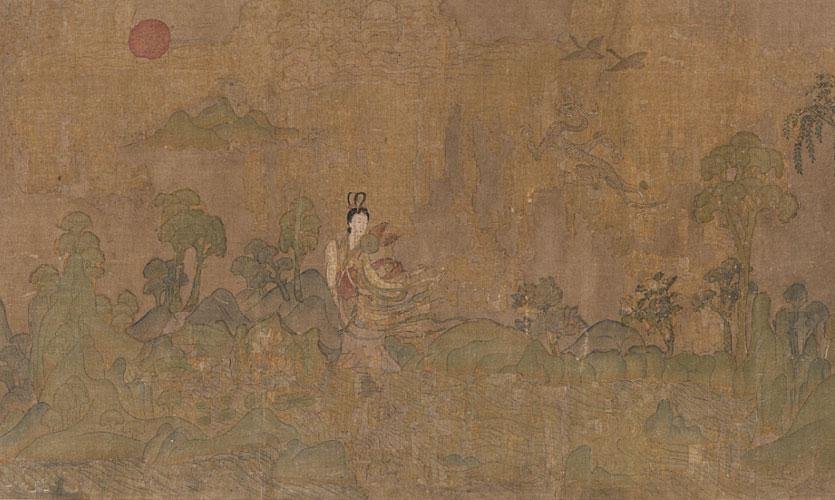
Artwork Basic Information
- Accession Number: New 00147329
- Period & Artist: Jin Dynasty (attributed to Gu Kaizhi), Song Dynasty (copy)
- Medium: Ink and color on silk
- Dimensions: Height: 27.1 cm, Width: 572.8 cm
- Catalog Contributor: Xu Zhongling
Artwork Narrative & Style
This handscroll is a Song Dynasty copy of Gu Kaizhi’s original work, inspired by Ode to the Luo Goddess—a poetic masterpiece by Cao Zhi (192–232 CE), a prominent literatus of the Three Kingdoms period (220–265 CE). The scroll unfolds as a narrative painting, depicting key scenes from the poem with rhythmic compositional coherence.
Opening scenes portray Cao Zhi encountering the Luo River Goddess on the banks of the Luo River: Cao Zhi steps forward, gazing at the goddess who appears fleetingly—described in the poem as having “shoulders as chiseled as jade, a waist as slender as silk thread, towering cloud-like hair, and delicate arched eyebrows”—hovering between presence and absence, coming and going in an ethereal manner. In the latter sections, the goddess departs in a cloud carriage drawn by six dragons, accompanied by jade phoenixes, patterned fish, and giant whales. She looks back with reluctance, her expression conveying the sorrow of inevitable separation, capturing the emotional core of Cao Zhi’s poem.
Artistic Characteristics
The scroll divides the poem’s content into sequential sections, with the main figures recurring to follow the poetic narrative. It features rich, vibrant coloring and an archaic, unrefined painting technique characteristic of pre-Early Tang Dynasty art: mountains and trees are outlined and filled with color (no texture strokes, or cun), with “trees depicted as if stretching arms and spreading fingers”—a style summed up by the classic critique “figures larger than mountains, water not enough to float a boat.”
While the scroll bears no transcription of Ode to the Luo Goddess nor signed marks of the artist, scholarly analysis of its painting technique, silk material, and pigmentation confirms it is a Song Dynasty copy. Despite this, it retains the artistic charm of the Six Dynasties (222–589 CE), consistent with the style attributed to Gu Kaizhi’s original work.
Inscriptions, Seals & Provenance
The frontispiece of the scroll features a running-script inscription by the Qianlong Emperor (Emperor Gaozong of Qing) reading “Miaoru Haodian” (Subtlety Reaching the Tip of the Brush). At the end of the scroll are colophons in running script attributed to Zhao Mengfu (Yuan Dynasty), as well as poetic colophons by Li Kan, Yu Ji (Yuan Dynasty), Shen Du, and Wu Kuan (Ming Dynasty)—all later proven to be forgeries. It also bears a poetic inscription by the Qianlong Emperor.
Numerous imperial seals are impressed on the scroll, including: “Mingchang” (Jin Dynasty), “Yufu Baohui” (Imperial Treasury of Paintings), “Qunyu Zhongmi” (Treasures of the Jade Group), “Mingchang Yujian” (Imperial Appreciation of Mingchang) from ancient imperial collections; and seals of the Qing Imperial Household, including those of the Qianlong, Jiaqing, and Xuantong Emperors.
The artwork is recorded in Shiqu Baoji·First Compilation (Imperial Catalog of Paintings and Calligraphy, First Series) and Shiqu Suibi (Random Notes on the Stone Moat Collection)—key Qing imperial catalogs of artworks.