
Art History Insights
Giuseppe Castiglione: The Cross-Cultural Visionary of Qing Court Painting
Beijing, 1743. As dawn breaks over the Forbidden City, 66-year-old Giuseppe Castiglione (known in China as Lang Shining) prepares his palette. The Italian Jesuit mixes Western pigments with Chinese ink, his brush hovering over silk. Sunlight glints off the glazed tiles of the imperial palace as this Milan-born artist begins another day capturing the essence of imperial steeds for the Qianlong Emperor.
In this liminal space between East and West, Castiglione would create visual masterpieces that would transcend cultural boundaries. For nearly five decades, he served as court painter to three Qing emperors. But it was his equine portraits—particularly the renowned Ten Steeds series—that became powerful symbols of cultural synthesis.
The Fusion of Form and Spirit
Castiglione achieved what no artist before him had accomplished: a seamless marriage of European realism and Chinese aesthetics. He masterfully employed Renaissance techniques—anatomical precision, chiaroscuro, and linear perspective—while strictly adhering to traditional Chinese media.
His signature contribution was the “graduated wash” technique (tuiyunfa). By modifying Western sfumato for absorbent rice paper, he created astonishingly volumetric renderings of muscle and bone without the heavy oil buildup of European painting.
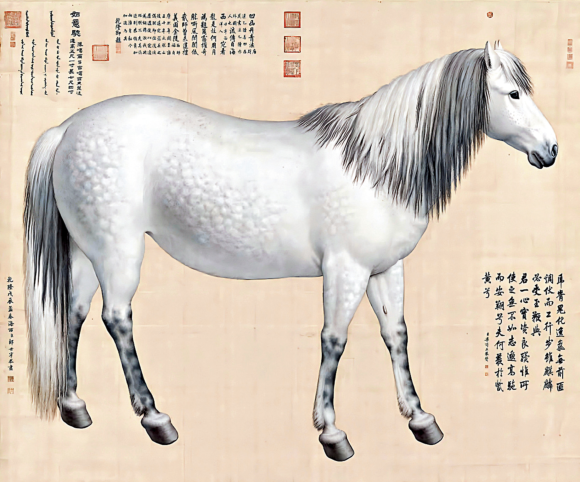
Giuseppe Castiglione, 1743. Ink and color on silk.
Notice the volumetric shading on the horse contrasted with the calligraphic, “boneless” style of the landscape.
However, his true genius lay in contextualization. Rather than placing his horses in European landscapes, Castiglione situated them within classical Chinese compositions—beside ancient pines, near misty streams, amidst poetic emptiness. This transformation elevated them from mere animals to spiritual symbols. Dubbed “Companions of the Dragon,” they embodied Confucian virtues of benevolence, courage, and resilience.
Hooves of Empire: Political Allegory
In Qianlong’s court, Castiglione’s steeds served as potent political symbols. The Ten Steeds series functioned almost as a visual tribute record, with each horse representing vassal states paying homage to the Qing throne.
“Castiglione’s horses weren’t just painted—they were conjured. Each muscle seems to ripple beneath the silk, embodying the controlled strength of the Empire.”
Castiglione intuitively understood art’s role in legitimizing power. His horses radiated controlled strength—muscular yet obedient, powerful yet disciplined. These visual metaphors proclaimed the empire’s might while subtly suggesting the allegiance of “all under heaven.”
The Bridge Builders
Castiglione’s achievements didn’t emerge in isolation. They stood atop decades of Sino-Western intellectual exchange pioneered by Jesuit missionaries and Ming scholar-officials:
- Xu Guangqi (1562-1633): Collaborated with Matteo Ricci to translate Euclid’s Elements.
- Li Zhizao (1565-1630): Introduced European astronomy to the Chinese court.
- Yang Tingyun (1557-1627): Synthesized Confucianism and Christian theology.
This bidirectional flow of knowledge—Western science eastward, Chinese philosophy westward—set the stage for Castiglione’s artistic synthesis.
Collector’s Insight
Today, authentic Castiglione works are among the most prized in the world, commanding extraordinary value at auction. For the discerning collector, the “Castiglione Style” represents a unique asset class: artifacts of early globalization.
Key identifiers of his school include:
- Anatomically precise musculature rendered with subtle, light-source shading.
- Hybrid compositions: European realism centered within Chinese landscape conventions.
- The presence of Imperial seals from the Qianlong era.
Bring the Imperial Aesthetic Home
Explore our curated collection of traditional paintings and high-quality reproductions honoring the legacy of the Qing Court.
A Dialogue Across Centuries
When we examine his prancing horses today, we see more than magnificent animals—we witness a historical moment when two great civilizations met as equals. Castiglione revealed a profound truth: authentic cultural exchange is never one-way transmission, but a transformative dialogue rooted in mutual respect.