
This bowl belongs to the long argument about Chinese porcelain: a porcelain body, thrown, glazed and fired until the surface turns to glass. the Cishan culture (Neolithic) workshop that made it treated whiteness and colour as a single problem to be solved in the kiln.
What looks like decoration is also a record. The motif was chosen, not incidental, and on a court vessel a repeat pattern is a way of saying order without using words.
The Cishan culture farmed millet and stored it in rounded jars, and its plain ware is a baseline against which later Chinese ceramics can be read.
A bowl like this outlived the hands that made it. It is why a porcelain vessel from the Cishan culture (Neolithic) dynasty still reads as a small piece of statecraft, fired and then forgotten by everyone but the collector.
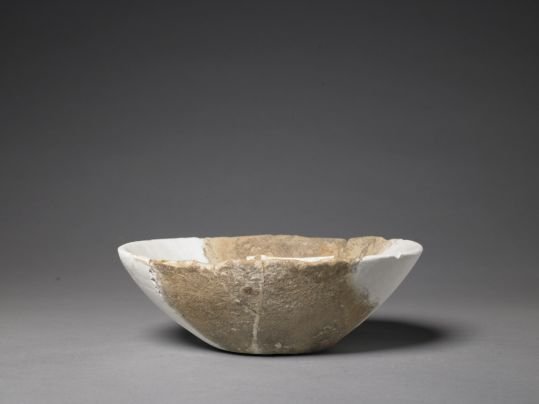
Object details
| Name | Imperial bowl (磁山文化红陶平底碗) |
|---|---|
| Artefact no. | |
| Technique | Imperial workshop |
| Period | Cishan culture (Neolithic) dynasty |
| Collection | The Palace Museum, Beijing |
| Source | Palace Museum Digital Collection (数字文物库) |
Image © The Palace Museum. View the original in the Palace Museum Digital Collection.