
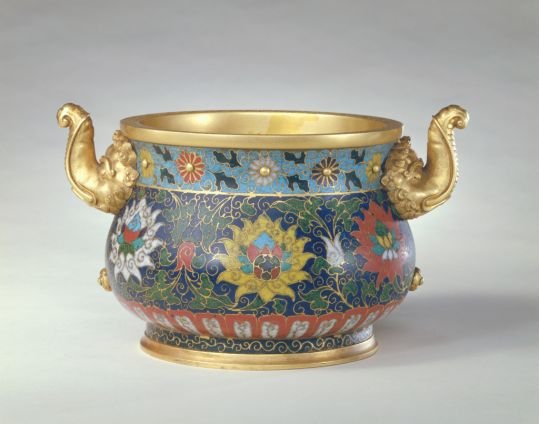
Two elephants lift this censer by the handles, trunks curled, as if offering the vessel upward. The Qing imperial workshop took the Ming cloisonne vocabulary and made it heavier, rounder, more crowded with good omen.
The body carries the old interlocking lotus, but the elephants are the news. An elephant, xiang, puns on the word for auspicious, and a pair of them turns a incense burner into a wish for peace and prosperity spoken in metal.
Censers burned scent in the court’s rooms and temples. This one is built to be carried in procession, the elephants making the weight legible as a gesture of offering rather than labour.
The Qing did not invent cloisonne. They inherited it from the Ming and then refused to leave it alone, adding beasts until the pattern could barely hold them.
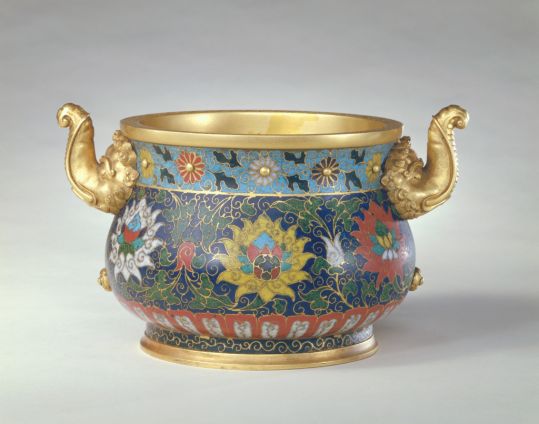
Object details
| Name | Cloisonne ‘Interlocking Lotus’ censer with elephant handles (掐丝珐琅缠枝莲纹象耳炉) |
|---|---|
| Artefact no. | 故00119789 |
| Technique | Cloisonne enamel (掐丝珐琅) |
| Period | Qing dynasty, imperial workshop |
| Collection | The Palace Museum, Beijing |
| Source | Palace Museum Digital Collection (数字文物库) |
Image © The Palace Museum. View the original in the Palace Museum collection.