
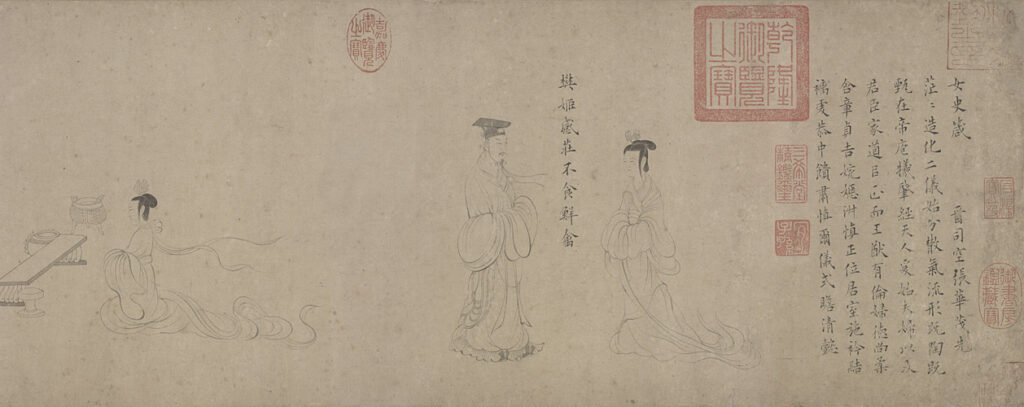
Gu Kaizhi is the name that opens the history of Chinese figure painting, and this scroll is why. Admonitions of the Instructress to the Court Ladies survives in the Palace Museum as a Song copy of his lost original.
The work illustrates a fourth century text addressed to palace women, a set of warnings about conduct illustrated with scenes of court life. Gu Kaizhi, who worked in the Eastern Jin, was credited with giving Chinese figure painting its first fully human sensibility. The faces, the gestures, the moral little dramas, all of it was new in his time.
We do not have Gu’s own hand. What we have is a careful Song dynasty copy, and copies are how most early Chinese masterpieces reach us. The Palace Museum scroll is one of the key witnesses. Its value is double. It preserves a lost original and it shows how a later age understood and revered that original.
The painting is also a document of female instruction as the court imagined it, a mix of ethics and surveillance. The instructress admonishes, the ladies comply or falter, and the brush records both. Read coldly, it is a manual for obedience illustrated by the best painter of his century.
To look at this copy is to look through two eras at once. The Song hand rebuilds the Jin idea, and we see both the lesson and the reverence.
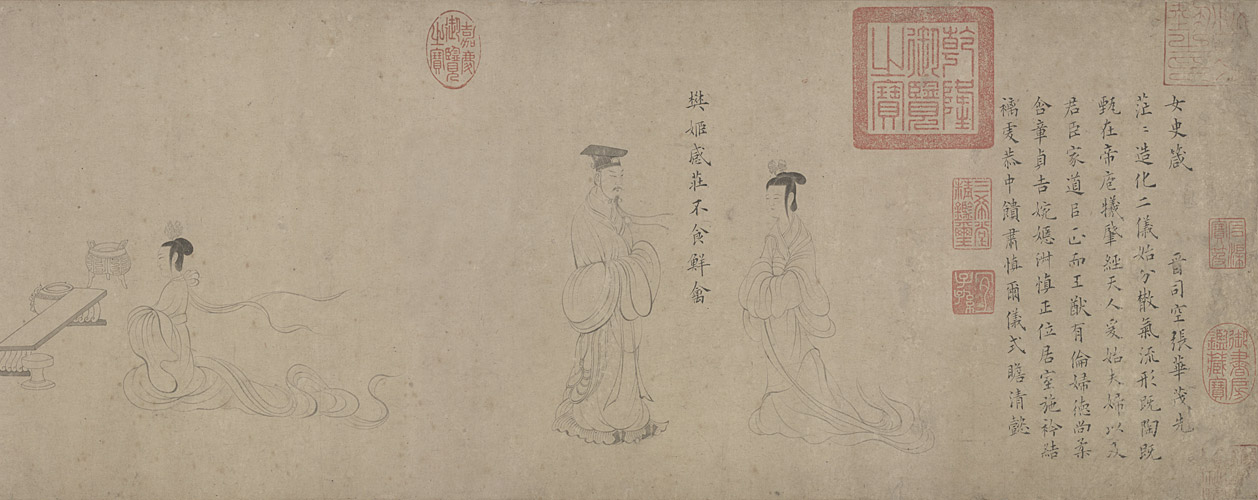
Object details
| Name | Admonitions of the Instructress to the Court Ladies (顾恺之女史箴图卷(宋摹)) |
|---|---|
| Artefact no. | 新00146320 |
| Category | Chinese Paintings (绘画) |
| Period | 人物 |
| Collection | The Palace Museum, Beijing |
| Source | Palace Museum Digital Collection (数字文物库) |
Image © The Palace Museum. View the original in the Palace Museum collection.