
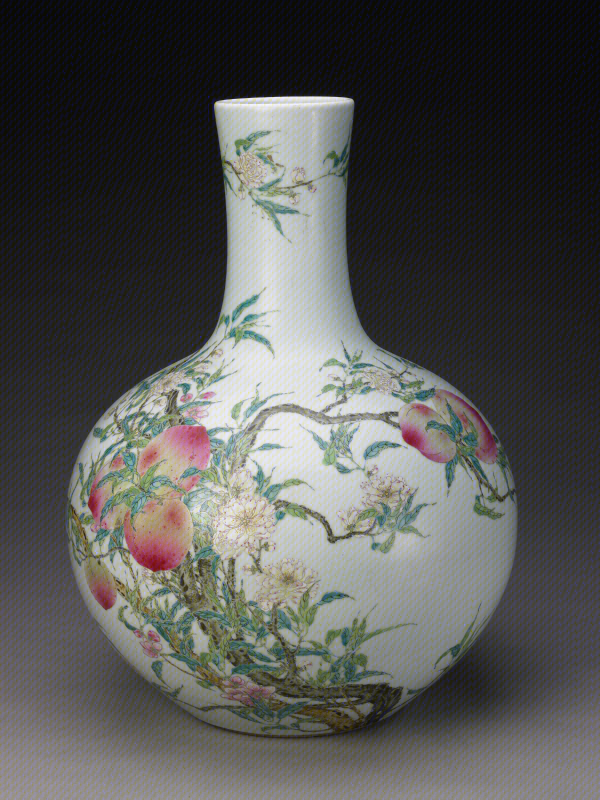
Object details
| Name | Qianlong-marked powder-enamel Nine-Peaches celestial-sphere vase (乾隆款粉彩九桃图天球瓶) |
|---|---|
| Artefact no. | 故00154701 |
| Category | Ceramics (陶瓷) |
| Period | Qing dynasty, Qianlong reign (1736–1795) (清乾隆) |
| Collection | The Palace Museum, Beijing (故宫博物院) |
| Source | Palace Museum Digital Collection (数字文物库) |
Every imperial porcelain vase is a small machine for sending a wish upward. This one sends the oldest wish of all.
The object is a Qianlong-reign powder-enamelled vase painted with nine peaches on a branching tree. In Chinese it is called 乾隆款粉彩九桃图天球瓶, the Qianlong-marked powder-enamel Nine-Peaches celestial-sphere vase. It lives in the Palace Museum, Beijing, catalogued as artefact no. 故00154701. It is porcelain, made during the Qianlong reign of the Qing dynasty, between 1736 and 1795.
The shape is the first thing to read. A celestial-sphere vase, or tianqiuping, has a near-spherical body and a long, straight neck, like a planet on a stand. The form did not begin in China. It descends from West Asian and Islamic metalwork, objects carried east along the trade routes and copied in Chinese porcelain during the early Ming, under the Yongle and Xuande emperors in the fifteenth century. The Qing court revived it three hundred years later, and the Qianlong workshop made it a vehicle for the most refined enamel painting of the age.
The surface tells you why. The decoration is fencai, often called famille rose in the West. It is an overglaze enamel technique perfected in the early eighteenth century, in which artists paint on top of the glazed body and fire the vessel a second time at a low temperature. The pink and ruby tones of the peaches come from a glassy lead-arsenate pigment, a material new to Chinese kilns in the Kangxi reign and still a mark of the highest court taste under Yongzheng and Qianlong. Where earlier enamels could look flat, fencai gives the fruit a soft, graded volume, as if lit from within.
The subject is the second thing to read, and it is not decorative by accident. Peaches are the fruit of longevity in Chinese culture. Nine is the largest of the yang numbers, the count that stands for completion and supreme fortune. A tree weighted with nine peaches is a picture of a long life granted in full measure. Porcelain of this kind was bound up with birthday rites at the Qianlong court, above all the celebrations for the Empress Dowager, the emperor’s mother. To set nine peaches on a vase was to wish the person who used it many decades more.
What survives is a quiet argument about power. The vase performs no violence, claims no conquest. It gathers a foreign shape, a new pigment, and an ancient wish, and holds them in balance. That is partly why it endures. A piece this composed does not need to shout. It simply offers the wish again, to whoever stands close enough to read it.
If you want to see the object itself, the Palace Museum’s digital collection holds the full record, including the catalogue photographs. Our text is a reading, not the institution’s own description, and the image is reproduced here with credit to The Palace Museum, Beijing.
Source: The Palace Museum, Beijing — 数字文物库 (Digital Collection). Artefact no. 故00154701.
Image: © The Palace Museum.