
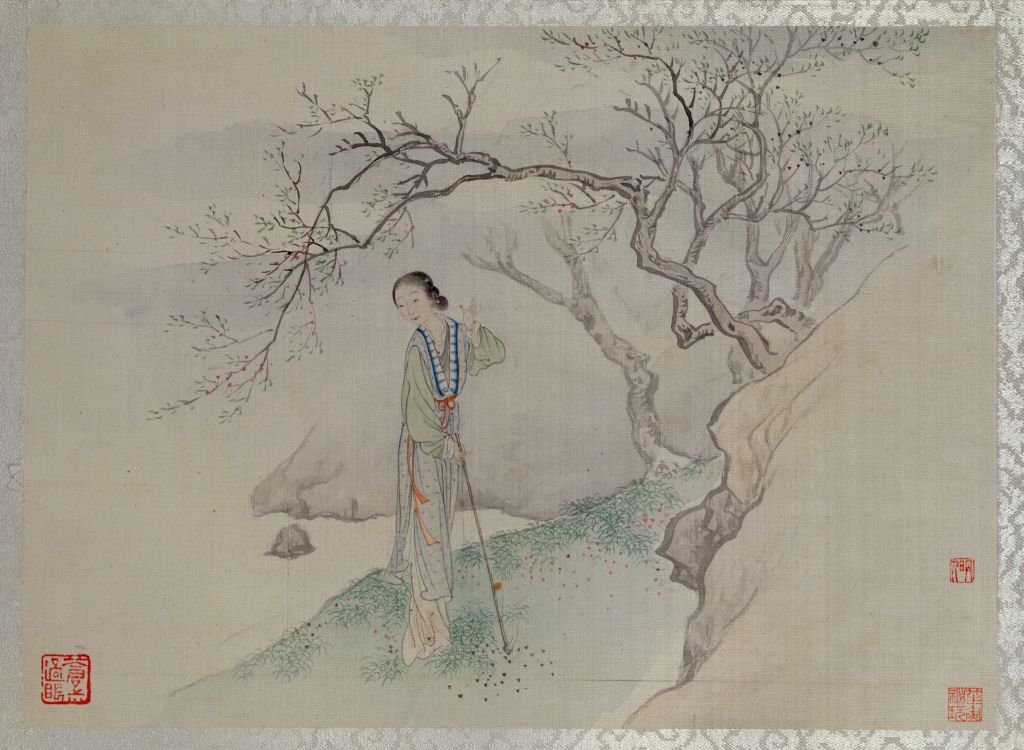
The Twelve Golden Hairpins
Fei Danxu’s Masterpiece of Late Qing Court Lady Painting
1841 • Qing Dynasty • Silk Album
ARTIST
Fei Danxu (1801–1850)
Courtesy name: Zitiao | Art name: Xiaolou
DATE
1841 (Daoguang Reign, 21st Year)
Xinchou Year of the Qing Dynasty
SPECIFICATIONS
Album of 12 Leaves
Ink and color on silk | 20.3 × 27.7 cm
Fei Danxu’s Twelve Golden Hairpins (1841) stands as a seminal work in the canon of late Qing Dynasty shinühua (court lady painting), offering a delicate visual interpretation of Cao Xueqin’s literary masterpiece, Dream of the Red Chamber. Commissioned by his close friend and patron “Lanting” when the artist was 40 years old, this album moves beyond mere portraiture to capture the psychological depth and tragic destiny of the novel’s twelve female protagonists.
To fully appreciate the narrative weight of these portraits, one must understand the complex web of relationships that define the “Red Chamber” world. The Twelve Beauties are not isolated figures but are bound by kinship, rivalry, and fate within the decline of the Jia clan.
Fei Danxu, a native of Wucheng (modern-day Huzhou, Zhejiang), was a central figure in the “Gai-Fei School” of painting, alongside his contemporary Gai Qi. While he had experimented with folk-style renditions of the novel in his youth, this mature work demonstrates a refined, scholarly aesthetic. His brushwork is characterized by a “boneless” (mogu) technique for the landscape elements, where forms are shaped by washes of ink and color rather than rigid outlines, creating a dreamlike, atmospheric quality that mirrors the ephemeral nature of the characters’ lives.
The “Gai-Fei” Aesthetic
Fei Danxu codified the visual language of the Qing Dynasty “Ideal Beauty.” His subjects are defined by:
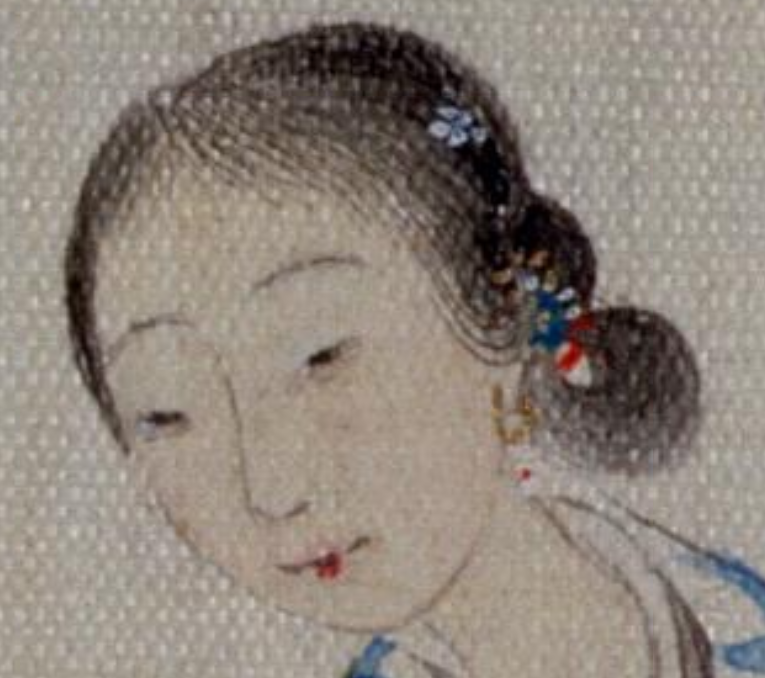
- The Duck-Egg Face (Yadan lian): A perfectly oval, smooth facial contour.
- Willow-Leaf Brows (Liuye mei): Long, slender, and slightly curved eyebrows evoking melancholy.
- Gallbladder Nose & Cherry Lips: Delicate features that emphasize refinement over realism.
“His court ladies… possess a refined grace. His landscapes are painted with a light touch, not strictly adhering to ancient methods, yet exuding a natural, unrestrained beauty.” — Qin Zuyong, Tongyin Lunhua (1876)
Technique & Conservation
The visual softness of the album is achieved through the Mogu (Boneless) technique. Unlike the rigid Gongbi style which relies on meticulous outlines, Mogu uses color washes to define shape and structure. This is particularly evident in the rendering of the mossy rocks and snowy trees that surround the figures.
Viewers may notice dark, mottled spots on the faces and robes of the figures. This is known as the “Lead Return” (Fan Qian) phenomenon. The white pigment traditionally used by Chinese masters contained lead (lead white, $2PbCO_3 \cdot Pb(OH)_2$). Over nearly two centuries, exposure to hydrogen sulfide in the air has caused the lead to oxidize into black lead sulfide ($PbS$). While a defect of age, it serves as an unintended certificate of authenticity for works of this era.
The Complete 12-Leaf Album
Ordered by Original Album Sequence
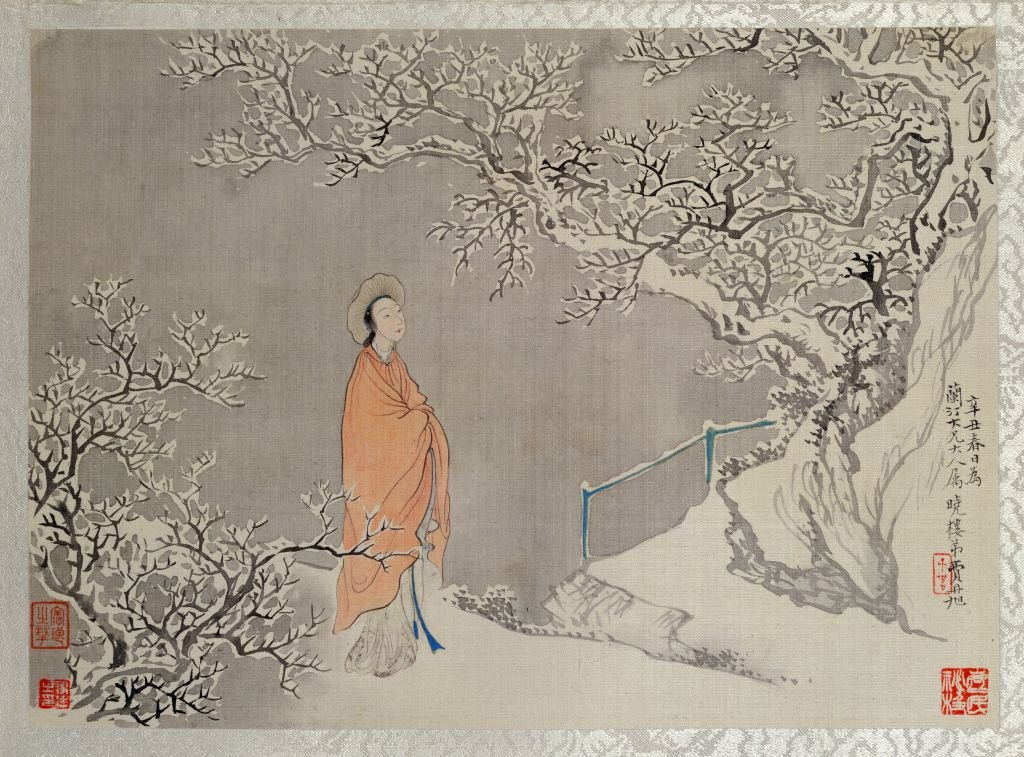
Treading on Snow (熙凤踏雪)
Sharp and commanding, even in the cold.
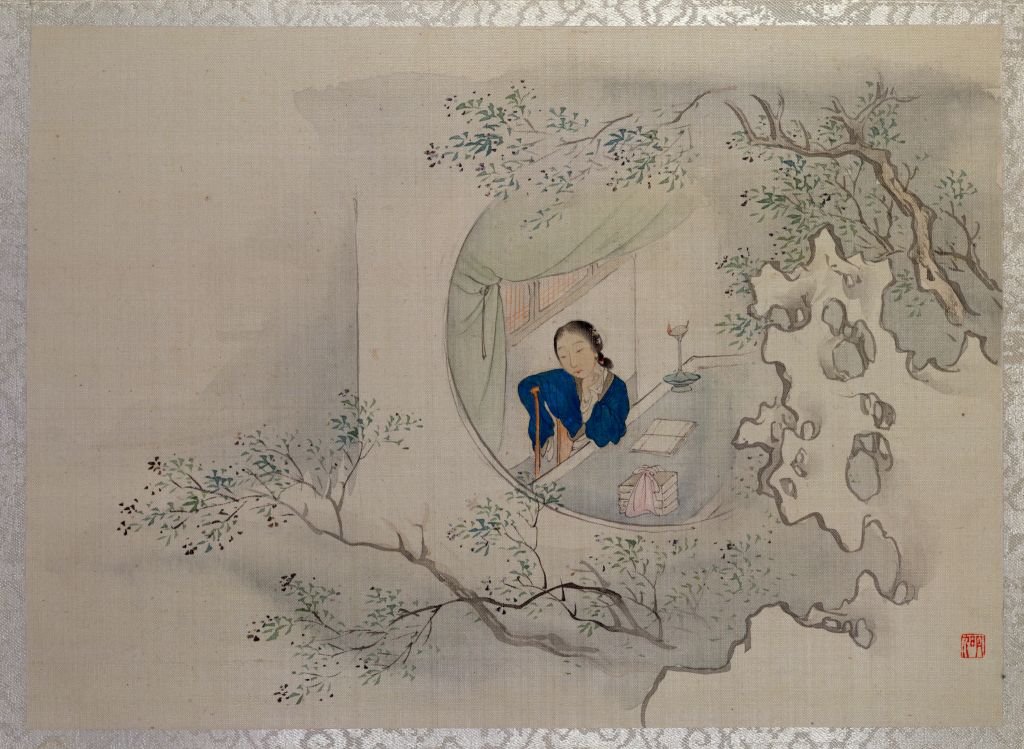
Land of Illusion (太虚幻境)
Framed by the circular window.
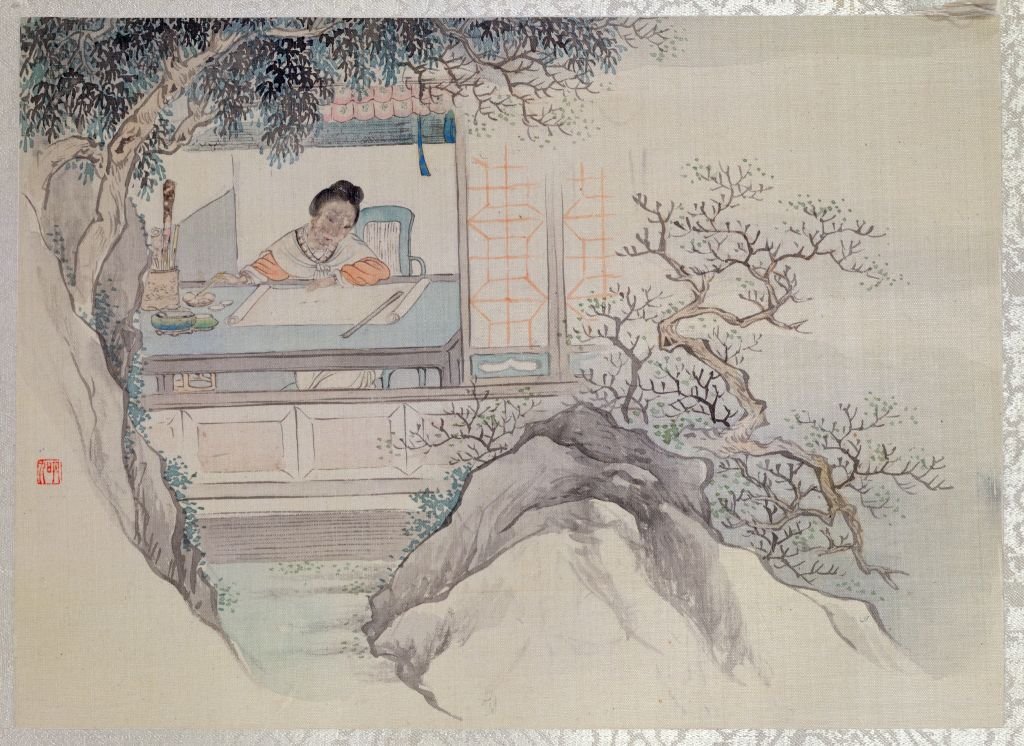
Painting the Garden (惜春作画)
Destined for the monastic life.
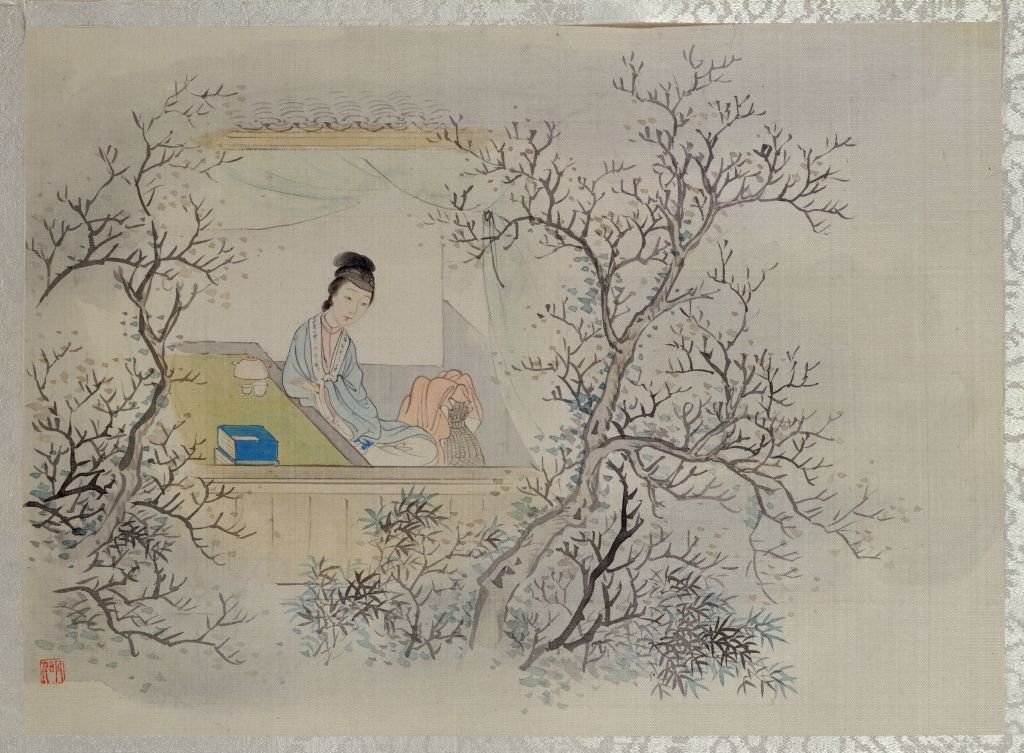
Tasting Tea (妙玉品茶)
Aloofness in the Green Lattice Nunnery.
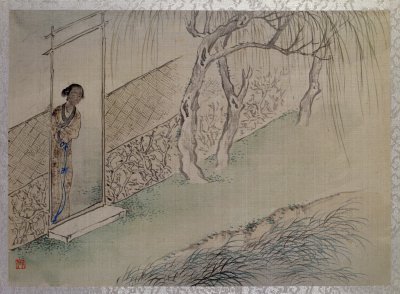
Refuge with Granny Liu (巧姐避居)
A twist of fate in a rustic setting.
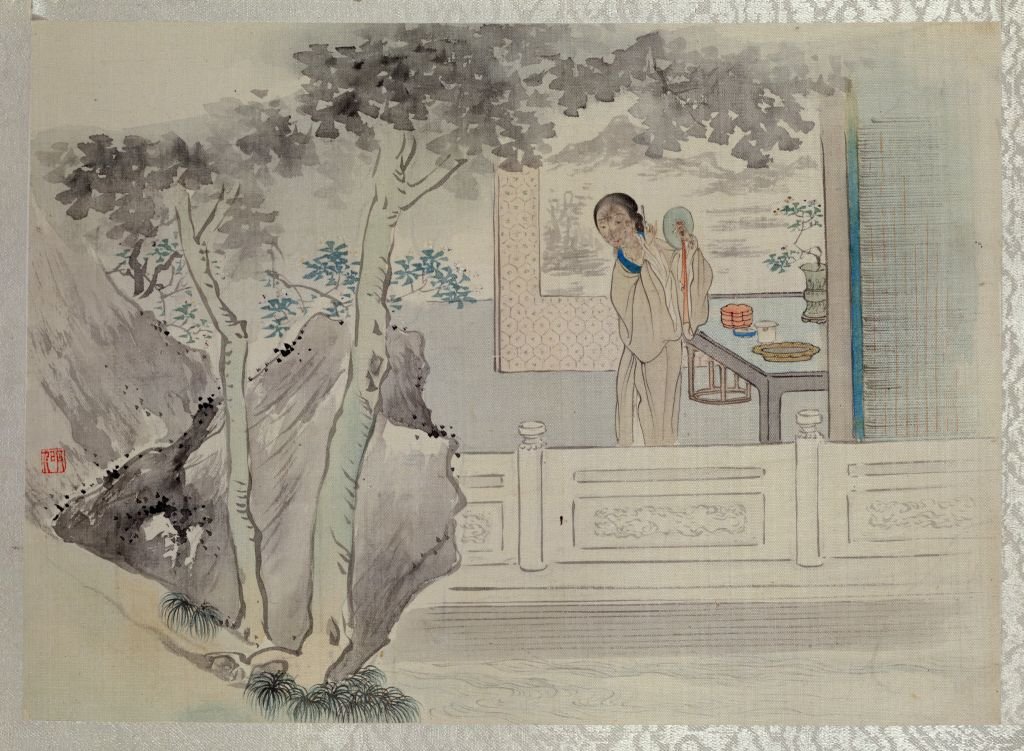
Applying Makeup (迎春理妆)
Quiet and yielding nature.
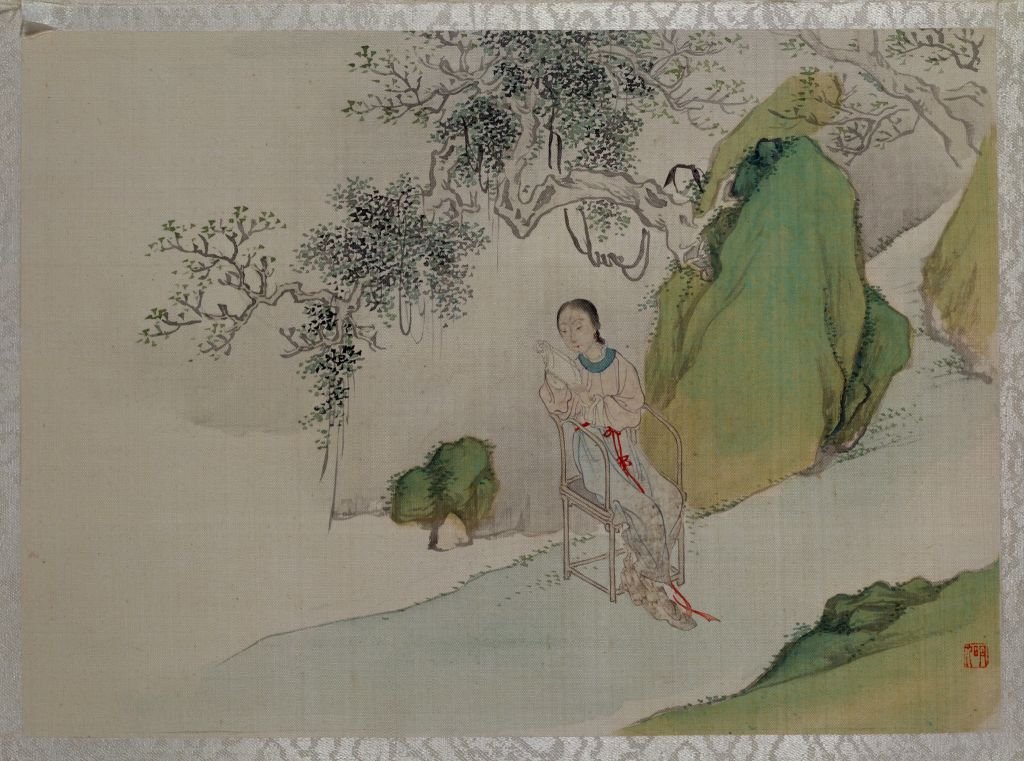
Reading (李纨读书)
The virtuous widow teaching her son.
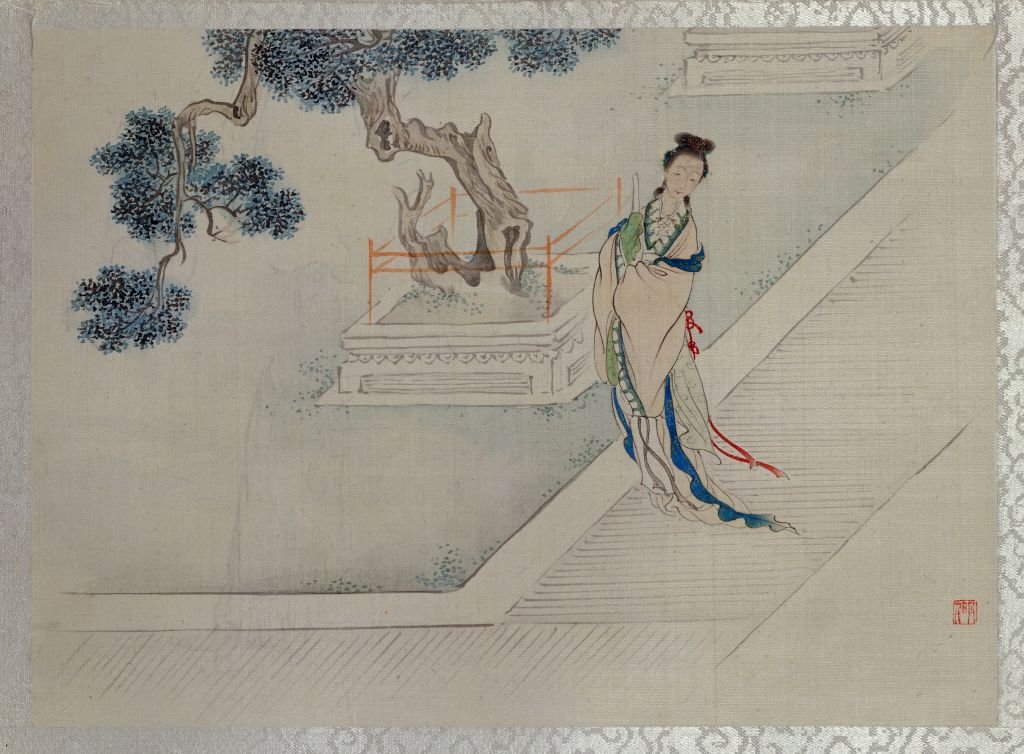
Selected for Phoenix Palace (元春才选)
Grandeur masking the family’s burden.
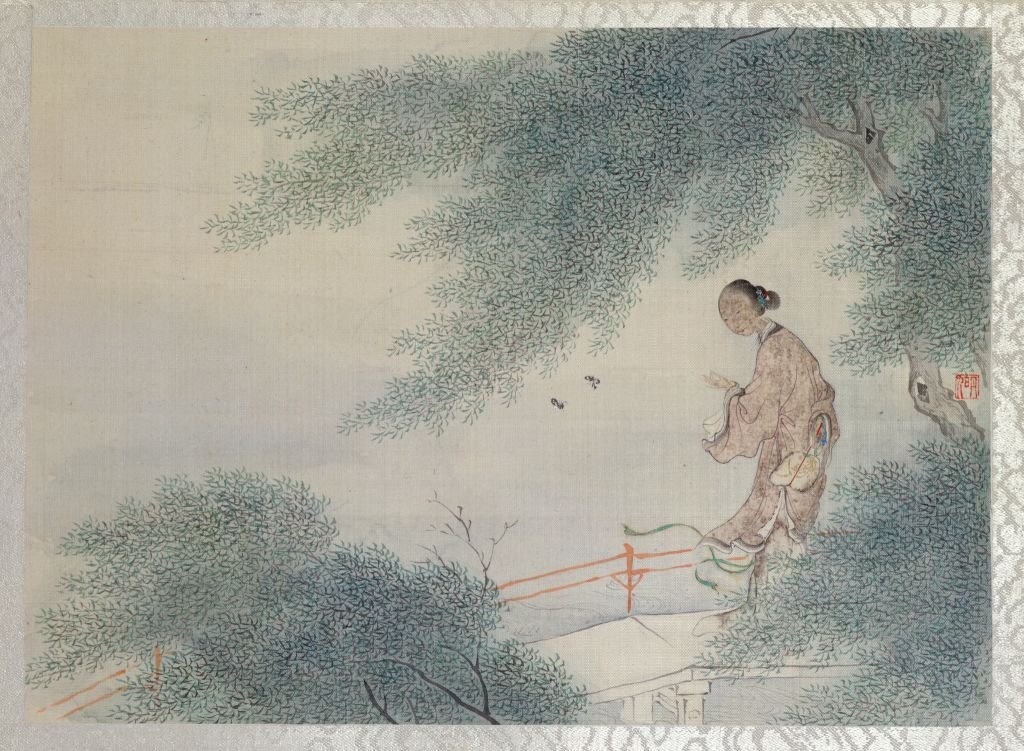
Chasing Butterflies (宝钗捕蝶)
A rare moment of youthful abandon.
Burying Flowers (黛玉葬花)
The epitome of poetic sorrow.
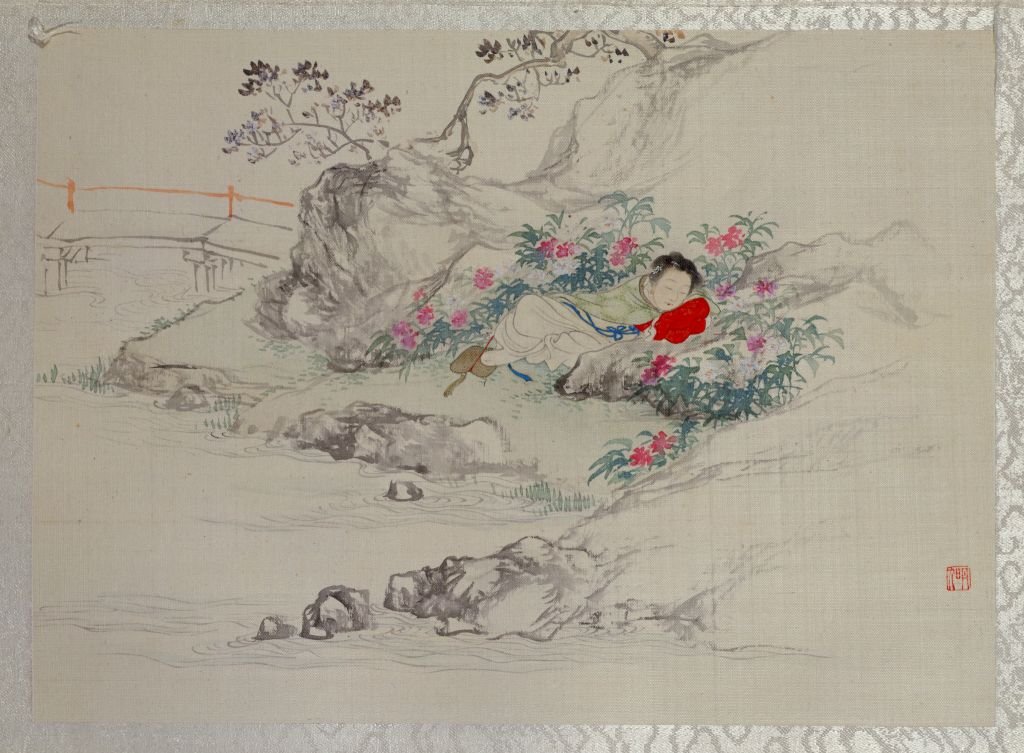
Drunk Amongst Peonies (湘云醉卧)
Carefree spirit in nature.
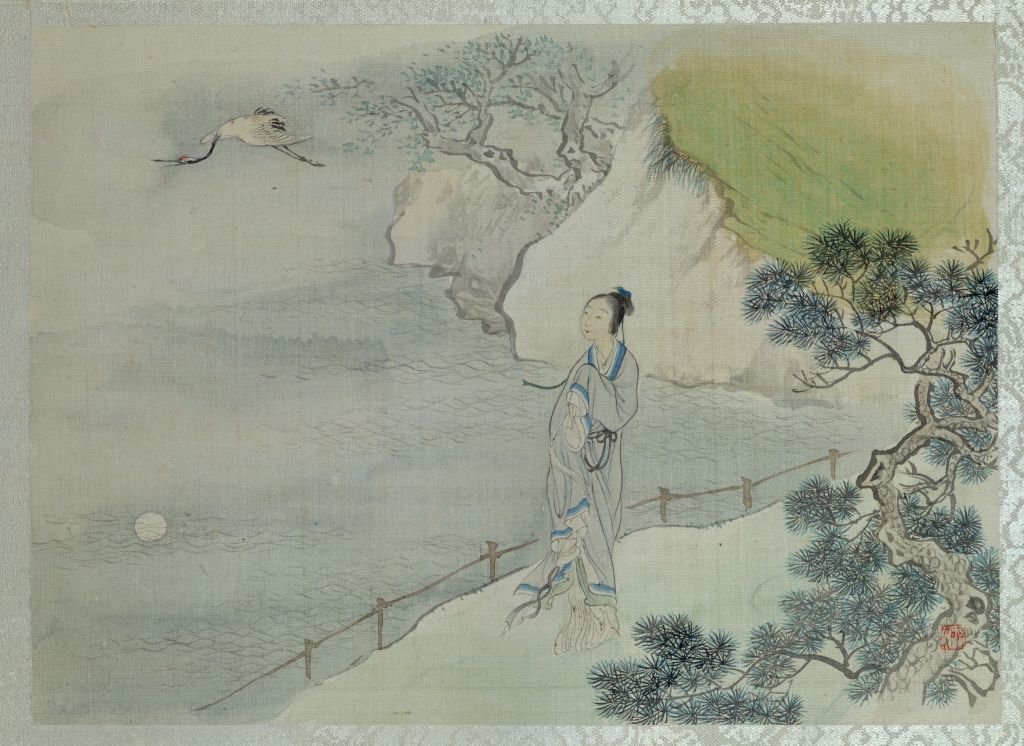
Marrying Far Away (探春远嫁)
A tearful departure for the capable sister.
This album remains a testament to the synthesis of literature and visual art in the 19th century, influencing generations of artists and the popular visual culture of the Yangliuqing and Taohuawu woodblock prints.