
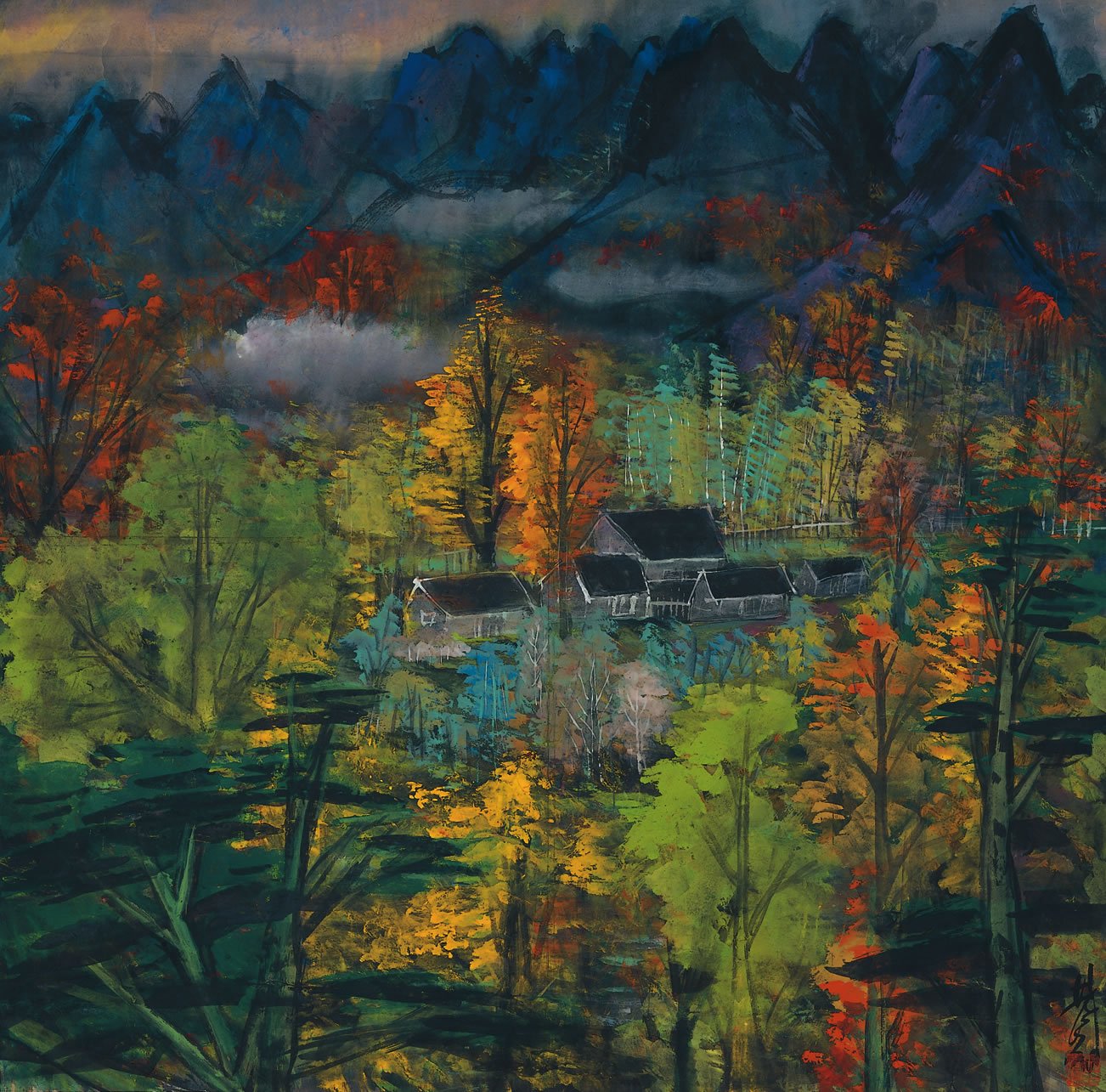
Autumn Landscape
Lin Fengmian (1900 – 1991)
- Date: 1977 – 1978
- Medium: Ink and color on paper (Square Format/Doufang)
- Dimensions: 67.5 x 68 cm
- Classification: Modern Chinese Painting
The Artist
Born in 1900, Lin Fengmian’s life paralleled the tumultuous history of the 20th century. He traveled to France in 1919 to study, graduating from the École Nationale Supérieure des Beaux-Arts in Paris. Upon returning to China in 1926, he immediately assumed the role of President at the National Beijing Art College. In 1928, he founded the National Academy of Art in Hangzhou (the predecessor of the China Academy of Art).
During the Second Sino-Japanese War, he retreated to Chongqing. After the war, he lived in solitude in Shanghai, creating art with intense dedication. During the Cultural Revolution, Lin suffered four years of unjust imprisonment, and his paintings were destroyed. In his later years, he settled in Hong Kong, dedicating the remainder of his life to his craft. Lin Fengmian wrote a rich chapter in the history of 20th-century Chinese art, mentoring giants such as Li Keran, Wu Guanzhong, Zao Wou-Ki, and Chu Teh-Chun. He is undeniably a grandmaster of his generation.
Style & Technique
Lin Fengmian pioneered the use of the square format for landscape painting, a departure from the traditional vertical or horizontal scrolls of Chinese landscape art. He had a particular fondness for depicting backlit scenery. In this work, he established a base with ink wash, layered with dots of red and yellow foliage, and added bright blues and deep purples around the mountains to create a backlit effect (contre-jour). Through this technique, he explored and reformed the relationship between color and light in Chinese painting, fusing Eastern and Western traditions.
This theme of autumn scenery largely stems from the artist’s trip to Tianping Mountain in Suzhou in the autumn of 1953. Following this trip, he told his students of his intention to create “New Landscapes.” From that point on, Lin Fengmian increasingly favored painting autumn scenes.
This specific piece, Autumn Landscape, created after his move to Hong Kong, utilizes the square composition that best reflects the artist’s structural characteristics. It uses perspective to display farmhouses nestled in an autumn forest. However, the cautious and meticulous style seen in his works from the 1950s through the 1970s has vanished completely, replaced here by a realm of free, uninhibited color.