
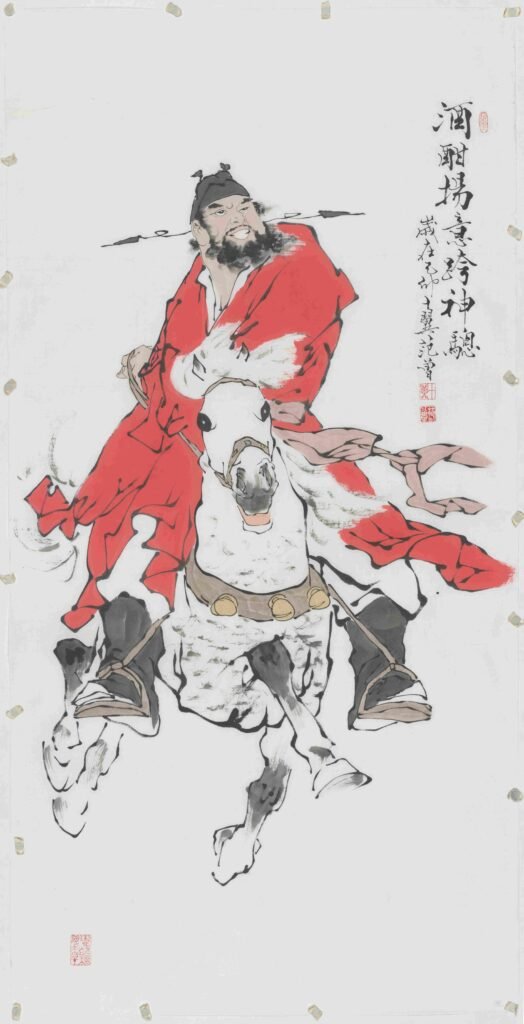
In Fan Zeng’s 2011 ink painting, Zhong Kui—China’s mythic “Ghost King”—leans forward on a galloping white steed, his crimson robe billowing like a flame, his eyes narrowed in a mix of ferocity and resolve. The brushstrokes are classic: “iron-thread lines” (rigid yet fluid) define his robe, a Tang Dynasty technique, while “orchid-leaf lines” (varying in thickness) give the horse’s muscles a sense of dynamic motion. It’s a image steeped in a thousand years of folklore, yet it feels remarkably alive. Now, that same figure is poised to gallop into the 21st century via Black Myth: Zhong Kui, an upcoming video game that’s already generating buzz among global gamers. The convergence of Fan’s classical art and the game’s cutting-edge design isn’t just a creative choice—it’s a symbol of how Chinese culture is reinventing itself for a global audience.
The Myth Reimagined: From Canvas to Console
Zhong Kui is no ordinary folk hero. In Chinese mythology, he’s a “ghost judge” (鬼判) who died unjustly as a Tang Dynasty scholar and was resurrected to protect humans from evil spirits. For centuries, he’s been depicted in paintings, operas, and New Year’s scrolls—often as a fearsome figure with a wild beard and crimson robe. But Fan Zeng’s interpretation added a layer of humanity: his Zhong Kui isn’t just a warrior; he’s a guardian driven by duty. “Fan made Zhong Kui relatable,” says Professor Li Meilin, a cultural studies expert at Peking University. “He’s ferocious to ghosts, but reassuring to humans. That duality is key to his appeal.”
Black Myth: Zhong Kui—developed by Game Science, the studio behind the 2024 hit Black Myth: Wukong—takes that duality further. The game will explore Zhong Kui’s backstory (his human life, his transformation) and add moral complexity: players will grapple with ethical dilemmas (e.g., sparing a repentant ghost) and question celestial rules. “We wanted to make Zhong Kui more than a ‘ghost catcher,’” says a Game Science spokesperson. “He’s a hero with flaws, a journey. That’s what modern audiences want.”
The game’s design draws directly from Fan’s work. Zhong Kui’s crimson robe will have 3D textures that make the folds look tactile, the horse’s golden harness will glint with detail, and the world—combining mortal villages, ghostly realms (yin), and celestial domains (yang)—echoes the “three realms” of Chinese mythology. Even the gameplay mechanics integrate traditional elements: players will use talismans (符), bells, and swords to exorcise spirits, blending Dark Souls-like combat with folk traditions.
Cultural Soft Power in the Digital Age
The timing couldn’t be better. Black Myth: Wukong became a global phenomenon in 2024, with its trailer garnering 50 million views on YouTube—largely thanks to its blend of traditional myth and Western-style gameplay. Zhong Kui is poised to build on that momentum. Early leaks of the game’s gameplay—showcasing Zhong Kui fighting ghosts in a mist-shrouded forest, conversing with celestial beings—have generated excitement among Western gamers. “The art style is incredible,” says a Reddit user from the U.S. “I don’t know much about Zhong Kui, but the story feels universal—protecting people from evil.”
That universality is key. Zhong Kui’s core theme—justice—resonates with audiences worldwide. Every culture has guardians (Thor in Norse myth, Archangel Michael in Christianity), but Zhong Kui’s “Chinese flavor” (crimson robe, ink-wash aesthetics, yin-yang philosophy) makes him unique. “Zhong Kui represents a new era of cultural confidence for China,” says Dr. Wang Yufeng, a researcher at the China Academy of Social Sciences. “Instead of exporting culture through government initiatives, they’re using commercial media—games, anime—to share stories that resonate. Zhong Kui’s universal theme of justice makes him the perfect ambassador.”
The Global Appeal of a Guardian
For global audiences, Black Myth: Zhong Kui offers something rare: a deep dive into Chinese mythology that’s accessible and engaging. The game’s developers have emphasized “global themes, local storytelling”: the plot (a hero fighting evil) is relatable, but the setting (Tang Dynasty China), characters (Zhong Kui, celestial bureaucrats), and mechanics (talisman use) are distinctly Chinese. “We want players to experience Zhong Kui’s world,” says the Game Science spokesperson. “To walk through a Tang Dynasty village, fight ghosts in a forest, and understand why he’s such an important figure in Chinese culture.”
Fan Zeng’s painting and Black Myth: Zhong Kui are two sides of the same coin: one honors the past, the other reimagines the future. Together, they show that Chinese culture isn’t just preserving its roots—it’s adapting to the present. “Tradition and modernity aren’t enemies,” says Professor Li. “They’re partners. Fan’s brushstrokes inspire the game, and the game brings Fan’s vision to a new generation.”
As Black Myth: Zhong Kui prepares to launch, it carries more than just gaming expectations—it’s a test of whether Chinese culture can thrive in the global pop culture landscape. For Fan Zeng, the game is a validation of his work: “Zhong Kui is a symbol of hope,” he says. “He protects the innocent, fights evil. That’s a message the world needs right now.” For global gamers, it’s a chance to discover a new hero—one who’s been guarding Chinese culture for a thousand years, and is now ready to guard the world.
In a chaotic world, Zhong Kui’s story is more relevant than ever. He’s a guardian who terrifies evil but protects the innocent—a message that transcends borders, languages, and mediums. And as he gallops from Fan’s canvas to the game console, he’s proving that Chinese culture isn’t just a part of the global conversation—it’s leading it.