
This vase belongs to the long argument about Chinese porcelain: a painted-enamel (falangcai) porcelain body, thrown, glazed and fired until the surface turns to glass. the 乾隆 workshop that made it treated whiteness and colour as a single problem to be solved in the kiln.
What looks like decoration is also a record. The motif was chosen, not incidental, and on a court vessel a repeat pattern is a way of saying order without using words.
Chinese ceramics carried the weight of a civilisation that measured its courts by what they could fire.
A vase like this outlived the hands that made it. It is why a painted-enamel (falangcai) porcelain vessel from the Imperial dynasty, 乾隆 reign (1736-1795) still reads as a small piece of statecraft, fired and then forgotten by everyone but the collector.
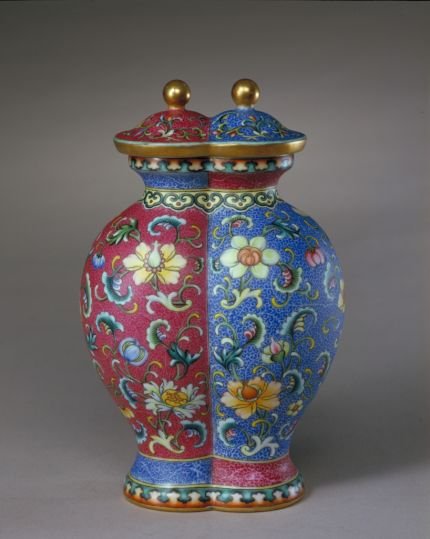
Object details
| Name | Qianlong period rouge red and blue ground rolled enamel albizia vase with folded branch pattern (乾隆款胭脂红蓝地轧道珐琅彩折枝花纹合欢瓶) |
|---|---|
| Artefact no. | 新00128098 |
| Technique | Painted-enamel (falangcai) porcelain (珐琅彩) |
| Period | Imperial dynasty, 乾隆 reign (1736-1795) |
| Collection | The Palace Museum, Beijing |
| Source | Palace Museum Digital Collection (数字文物库) |
Image © The Palace Museum. View the original in the Palace Museum Digital Collection.