
The piece is a ewer, and Painted-enamel (falangcai) porcelain is the technique that decides how it reads. The pattern is laid before firing, so the colour sits under a clear glaze, protected and luminous rather than painted on top.
A ewer of this kind was made to be seen closely and from afar at once. The painted-enamel (falangcai) porcelain ground rewards the near view; the silhouette does the work across a room.
The Yixing ware court understood porcelain as a statement of capacity. To fire a ewer without a flaw was to prove the workshop, and behind it the state, could do the impossible reliably.
The painted-enamel (falangcai) porcelain ewer is a quiet lesson in Chinese taste: control of fire first, beauty second, and the two arriving together. Sinocra carries the work, with more from The Palace Museum, in the shop.
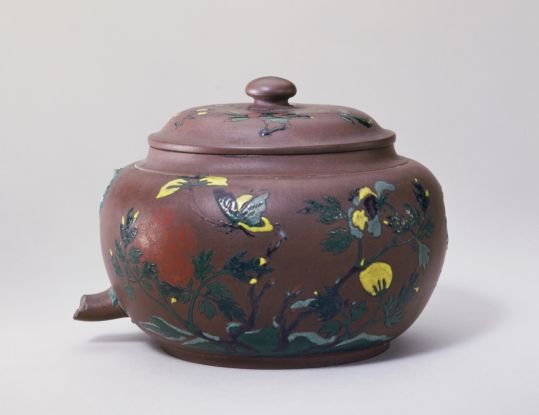
Object details
| Name | Yixing kiln “Shao Bangyou” purple sand enamel pot (宜兴窑“邵邦祐”款紫砂珐琅彩壶) |
|---|---|
| Artefact no. | 故00157112 |
| Technique | Painted-enamel (falangcai) porcelain (珐琅彩) |
| Period | Yixing ware dynasty (Ming to Qing) |
| Collection | The Palace Museum, Beijing |
| Source | Palace Museum Digital Collection (数字文物库) |
Image © The Palace Museum. View the original in the Palace Museum Digital Collection.